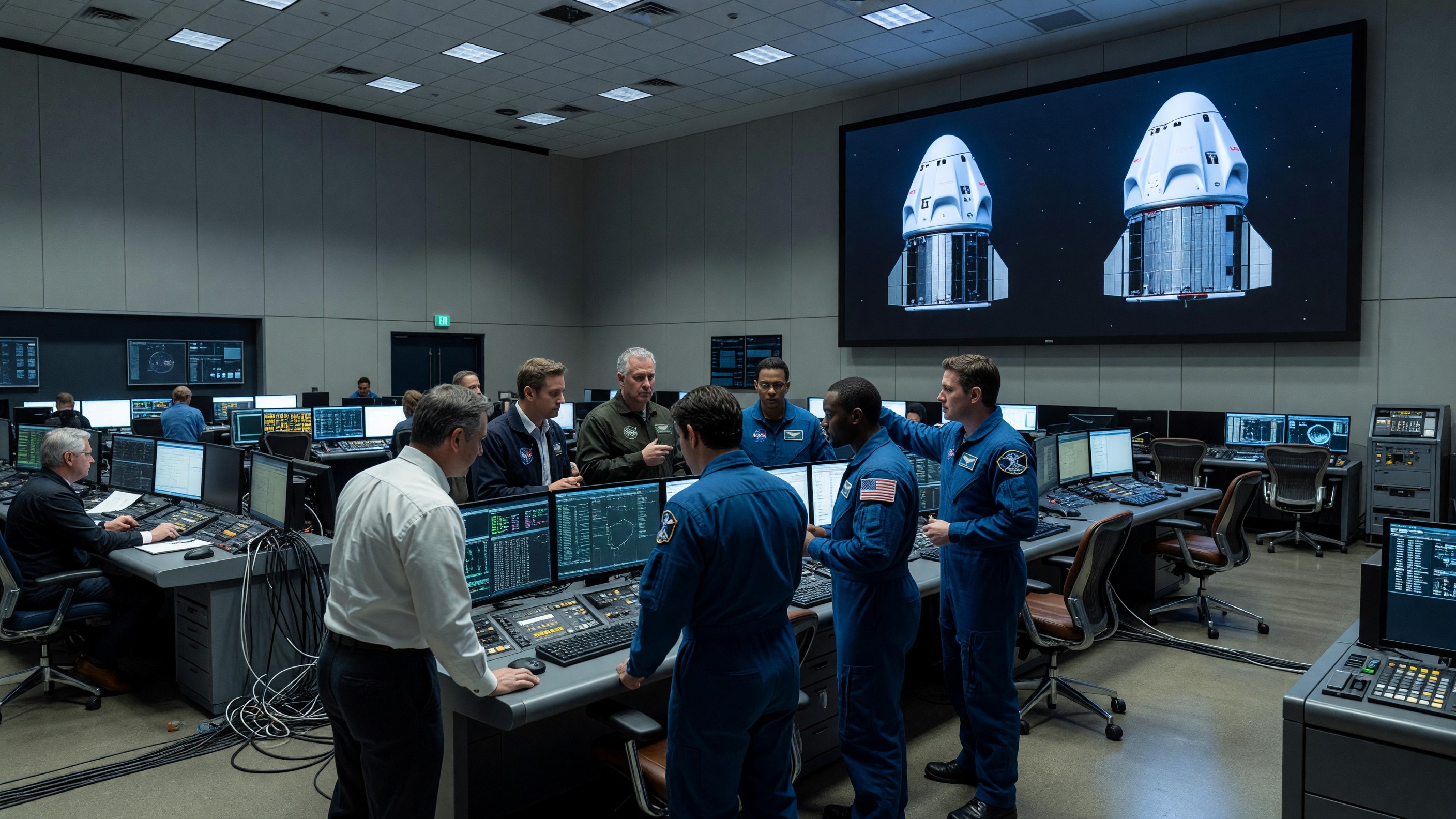
When Boeing’s CST-100 Starliner lifted off from Cape Canaveral on June 5, 2024, atop a United Launch Alliance Atlas V, the mission was supposed to validate the spacecraft as NASA’s second operational crew vehicle. NASA astronauts Butch Wilmore and Suni Williams — both veteran test pilots and longtime ISS visitors — were aboard for what was planned as a roughly week-long Crew Flight Test (CFT). They would dock with the International Space Station, spend several days demonstrating the vehicle’s on-orbit performance, and return home before the end of the month.
That is not what happened. By the time NASA made its return decision in late August 2024, the mission’s character had changed completely. Wilmore and Williams would remain aboard the ISS as members of the station’s standard crew complement. Starliner would undock uncrewed and return autonomously. And the astronauts who had flown up on Boeing’s vehicle would ultimately come home on a SpaceX Crew Dragon — a decision with implications well beyond the immediate mission.
The Mission as Planned, and What Went Wrong
The Crew Flight Test was the culmination of years of Starliner development, including an uncrewed Orbital Flight Test in 2019 that suffered software anomalies and never reached the ISS, and a successful uncrewed OFT-2 in 2022. CFT was the final certification step. A successful crewed demonstration would clear the way for Starliner to enter operational rotation alongside SpaceX’s Crew Dragon, giving NASA the dual-provider redundancy that the Commercial Crew Program was designed to deliver.
Two technical issues defined the flight. The first was helium leakage in the spacecraft’s service module propulsion system. A small helium leak had been identified before launch and judged acceptable to fly, but additional leaks appeared once Starliner was on orbit. Helium is used to pressurize the propellant tanks that feed the reaction control system and orbital maneuvering thrusters; while leaks of this scale do not pose an immediate crew safety threat, they constrain the vehicle’s propellant budget and complicate planning.
The second and more significant issue was thruster performance. During the approach and docking phase, five of Starliner’s 28 reaction control system thrusters performed below specification, with several temporarily failing entirely before being recovered through hot-fire testing on orbit. Boeing and NASA conducted extensive ground testing of a replica thruster at White Sands during the summer to understand the failure mode, which appeared to involve thermal effects on a Teflon seal within the thruster’s poppet valve, restricting propellant flow.
NASA and Boeing both publicly emphasized for weeks that they were working through the data and that no decision had been made. NASA’s Commercial Crew Program provided regular updates throughout the summer, and senior agency officials repeatedly characterized the situation as one of caution rather than alarm.
The Decision
In late August 2024, NASA announced its decision: Wilmore and Williams would remain on the ISS and return on SpaceX’s Crew-9 Dragon, scheduled to launch in September with only two crew members instead of four to leave seats available for the returning astronauts. Starliner would undock uncrewed and attempt an autonomous landing at White Sands.
NASA Administrator Bill Nelson and senior program officials framed the choice in terms of risk posture. The thruster anomalies could not be fully characterized in flight, and while engineering analysis suggested the spacecraft could probably bring the crew home safely, “probably” was not the standard the agency wanted to apply to a crewed re-entry when an alternative existed. The decision was, by NASA’s own account, a deliberate exercise of the redundancy that the Commercial Crew Program had been designed to provide.
Boeing publicly disagreed with the assessment that Starliner could not safely return the crew, but accepted NASA’s authority over the decision. Starliner undocked from the ISS on September 6, 2024, and successfully landed at White Sands Space Harbor several hours later. The uncrewed return was, by most technical measures, a clean flight — the thrusters that had been problematic on the way up performed adequately on the way down, and the spacecraft executed its de-orbit burn, parachute deployment, and airbag-cushioned touchdown nominally.
Wilmore and Williams returned to Earth aboard Crew Dragon in late September 2024 as part of the Crew-9 rotation.
What the Mission Revealed
The most important takeaway is that NASA’s commercial crew redundancy strategy worked. The Commercial Crew Program was structured specifically to avoid the situation that followed the Space Shuttle’s retirement — a multi-year period in which NASA had no domestic crewed launch capability and depended entirely on Russian Soyuz seats. By contracting two providers, the agency ensured that an anomaly with one vehicle would not strand crews or halt ISS operations.
In practice, that redundancy had been theoretical until the summer of 2024. SpaceX’s Crew Dragon, which entered service in 2020, had carried every NASA commercial crew mission to date. Starliner had been delayed by years and had not flown operationally. The CFT issues forced the redundancy to actually function — and it did. Crew Dragon flew Crew-9 with reconfigured seating to bring Wilmore and Williams home, and ISS operations continued without interruption.
The second takeaway is harder for Boeing. Starliner’s path to operational certification is significantly more complicated following CFT. NASA has not formally declared the vehicle uncertifiable, and Boeing has stated its intent to continue the program, but the thruster and helium issues will require design changes, additional testing, and potentially another uncrewed or crewed demonstration flight before NASA approves operational rotation missions.
The Atlas V that launched Wilmore and Williams was one of the last in ULA’s inventory committed to the Starliner program. Future Starliner missions are expected to fly on Atlas V using boosters already produced, but the long-term launch vehicle for Starliner — given that Atlas V is being retired in favor of the Vulcan Centaur — remains an open question.
Implications for the Commercial Crew Architecture
NASA officials have been consistent in stating that the agency remains committed to maintaining two commercial crew providers. The logic that drove the program’s creation has not changed: a single-provider architecture creates unacceptable risk for crew transportation to the ISS and, eventually, to commercial low-Earth-orbit destinations that will succeed the station.
But the practical picture has shifted. Crew Dragon is now carrying the entire near-term operational load. Starliner’s return to operational status, when it happens, will restore the intended two-provider model — but the gap between “intended” and “operational” is real.
There is also a broader policy question that the CFT outcome has sharpened. The Commercial Crew Program’s fixed-price contracting model — in which providers absorb cost overruns — has been a financial strain for Boeing, which has disclosed substantial losses on the program over multiple years. Whether the model produced the right incentives for a program of this technical complexity is now a live debate in space-policy circles, and the answer will shape how NASA structures future human-rated procurements.
What Comes Next
Starliner’s next steps depend on Boeing’s analysis of the thruster failures and NASA’s certification posture. A redesign of the affected thruster components is likely, and an additional test flight — possibly uncrewed — may be required before operational rotation missions. The timeline remains uncertain.
For the broader commercial crew picture, the CFT outcome is a reminder that human spaceflight is hard, that redundancy is worth what it costs, and that mature programs sometimes look like the one that came home on a different rocket than the one that took it up.
Frequently Asked Questions
Q: When did Starliner launch with crew, and who was aboard? A: Starliner launched on its Crew Flight Test on June 5, 2024, carrying NASA astronauts Butch Wilmore and Suni Williams to the International Space Station.
Q: Why did NASA decide to return the crew on Crew Dragon? A: NASA cited unresolved questions about Starliner’s reaction control system thrusters and helium leaks in the service module. With Crew Dragon available as an alternative, the agency chose the lower-risk return path.
Q: Did Starliner return safely to Earth? A: Yes. Starliner undocked uncrewed on September 6, 2024, and landed nominally at White Sands Space Harbor in New Mexico.
Q: Is Boeing’s Starliner program continuing? A: Boeing has stated its intent to continue Starliner. However, NASA certification for operational rotation missions will require resolving the thruster and helium issues identified on CFT, which may involve additional testing or flights.
Q: What does this mean for NASA’s commercial crew redundancy strategy? A: It validated the strategy in practice — the redundancy that had been theoretical until 2024 actually functioned when needed. But it also means Crew Dragon is carrying the entire operational load for the foreseeable future.
Q: When did Wilmore and Williams return to Earth? A: They returned in late September 2024 aboard SpaceX’s Crew Dragon as part of the Crew-9 mission rotation.