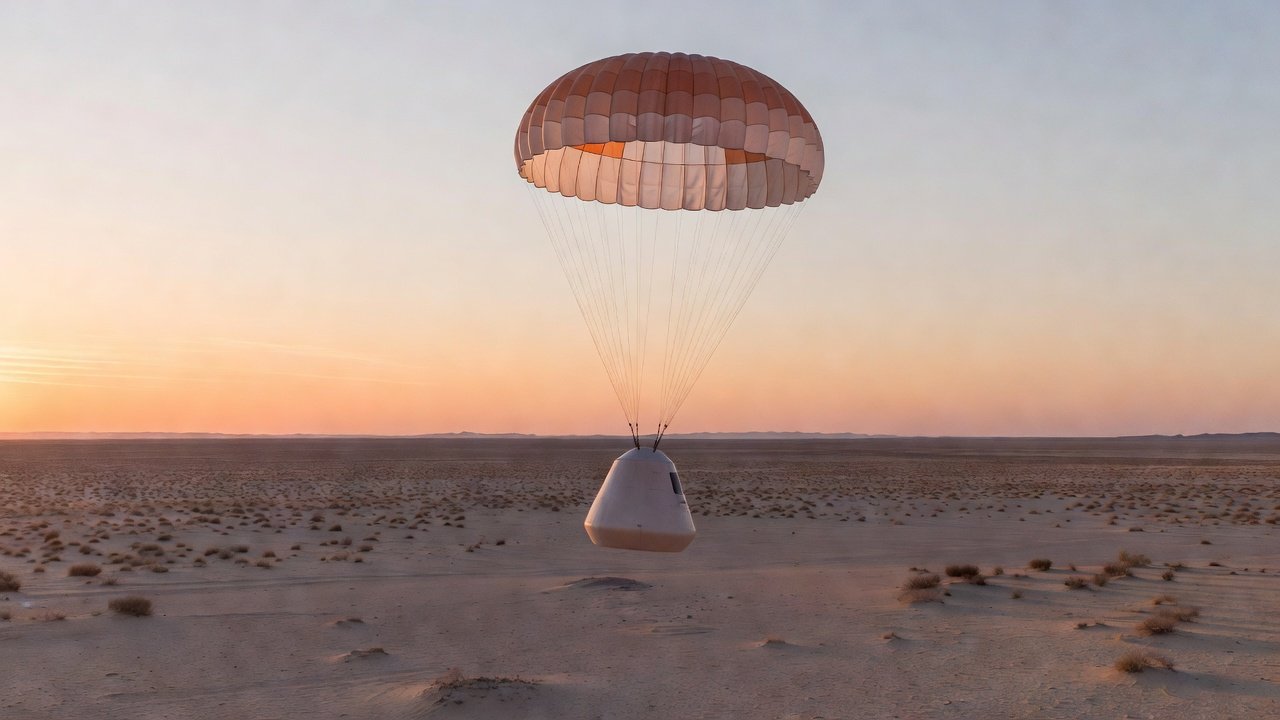
The next Starliner flight will not carry astronauts, and it will not fly in April. In November 2025 NASA and Boeing modified the Commercial Crew contract so that Starliner-1 became an uncrewed cargo mission to the International Space Station, initially targeted for no earlier than April 2026. Boeing’s own Starliner-1 status page now gives the target as December 2026 or January 2027. The certification question is therefore not “when do crews fly again” but “what does a cargo flight have to demonstrate before a crew is allowed on board.”
How the contract changed
Before the modification, Boeing was on contract for six operational crew rotation flights. Under the November 2025 contract modification, the firm order dropped to four flights: the Starliner-1 cargo mission plus three crewed rotations, with two further flights held as options. Reporting on the modification put the contract’s current value at about $3.73 billion, with a potential value near $4.46 billion if options are exercised.
NASA’s Commercial Crew Program manager, Steve Stich, said the change would let the agency and Boeing focus on certifying the system safely, execute Starliner’s first crew rotation “when ready,” and align later flights with the station’s needs through 2030. The phrase “when ready” carries the weight. It replaces a calendar with a condition.
The 2030 horizon matters as much as the flight count. The ISS is scheduled to be retired around then, so the window in which a second crew vehicle has operational value is finite. Each slip shortens the period in which Starliner can deliver the redundancy the program was built to provide.
What the 2024 flight left unresolved
Starliner’s Crew Flight Test in June 2024 docked with the station but suffered degraded reaction control thrusters and helium leaks on the way. The two crew members returned on a SpaceX Crew Dragon in 2025, and Starliner came home uncrewed in September 2024. NASA and Boeing then worked through a list of in-flight anomalies.
According to Boeing’s current status page, 19 of 21 in-flight anomalies from that flight are closed, with the remaining two expected to close in October. Boeing also says corrective action plans are in place for all eight recommendations of the review team that examined the flight, and that hardware and software work is complete, with validation still under way. Those are Boeing’s statements about its own progress. NASA’s closure of the same items is what counts toward certification, and NASA’s Starliner pages, not the operator’s, are the authoritative record of what has been accepted.
The remaining engineering work is specific:
- Crew module thrusters. Boeing lists replacing the valves on all 12 crew module reaction control thrusters and adding corrosion prevention measures.
- Service module thrusters. The thruster poppets, the valve components at the centre of the 2024 performance problems, are being redesigned.
- Parachute joint. A design improvement to a parachute joint is in the plan.
- Batteries. Upgraded battery systems are being integrated.
The condition that shapes the schedule
The most important line on the status page is the least dramatic. Boeing states that some of the mitigations require an in-flight demonstration on Starliner-1. That is the reason a cargo flight comes first. Ground test can screen a redesigned poppet but cannot fully reproduce the thermal and duty-cycle environment of docking, station keeping and departure. A flight with no one aboard is the way to get that data without putting a crew at risk.
It also means Starliner-1 is a real test, not a formality. Certification of crew rotation depends on the outcome of a flight that has not happened, on hardware whose final configuration is still being validated. If the flight reveals a new anomaly, the sequence resets.
What Boeing still has to prove
Pulling the public record together, four things stand between the current state and a crewed rotation:
- Anomaly closure accepted by NASA. Two items remain open by Boeing’s account, and the agency has to agree they are closed, not only Boeing.
- Redesigned thruster hardware performing in flight. The service module poppet redesign has to show consistent performance across a full docking-and-departure sequence, since the 2024 thruster degradation occurred during the approach.
- Cargo flight completed cleanly. Starliner-1 has to launch, dock, operate and return without a new safety-relevant issue.
- A launch vehicle and schedule to match. The July 2026 reporting noted six Atlas V rockets remain in inventory, all committed to Starliner, with launch dates for those flights undefined. Atlas V’s inventory is finite, and Boeing has not publicly detailed plans for the two remaining contracted flights beyond the four firm orders.
What this means for the wider commercial crew picture
NASA’s fixed-price commercial crew model was designed so that a second provider would keep the station crewed if one vehicle was grounded. That worked as intended in 2024, when Crew Dragon returned the Starliner crew. But an untested second provider is redundancy on paper. Every month that Starliner-1 slips is another month in which the station’s crew transport depends on a single flown vehicle.
Boeing has reported large losses on the program, with reporting on the contract modification putting the cumulative figure near $2 billion. That is a business fact more than a certification one, but it shapes how much appetite there is to continue.
The watch list is short. First, whether the two remaining anomalies close on schedule in October. Second, whether the December 2026 or January 2027 target for Starliner-1 holds, or becomes another date that moves. Third, what NASA says on the record when the vehicle returns. Until that flight is complete and reviewed, a crew rotation on Starliner remains a plan and not a scheduled flight.