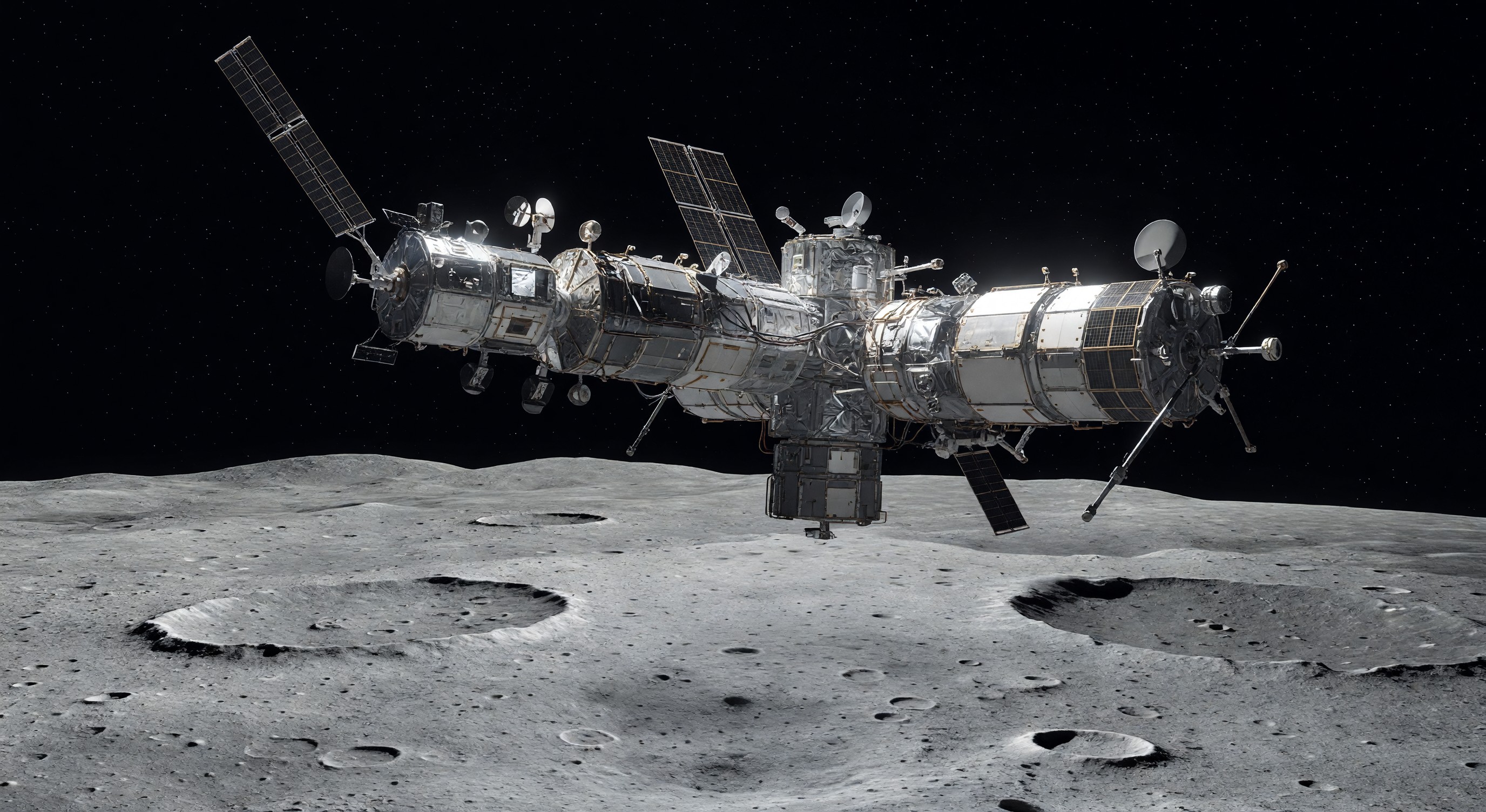
The Lunar Gateway — NASA’s planned space station in a near-rectilinear halo orbit around the Moon — is conceived as infrastructure for sustained human lunar presence. Unlike the International Space Station, which orbits at roughly 400 kilometers above Earth and is resupplied by a fleet of commercial and international vehicles on regular schedules, the Gateway would sit in a highly elliptical orbit that brings it as close as 3,000 kilometers to the Moon’s surface and as far as 70,000 kilometers away.
That unique orbit creates unique logistics challenges. The Gateway is not on the doorstep of Earth’s launch sites the way ISS is. Getting cargo there requires significantly more energy than ISS resupply — a Lunar Gateway cargo mission is fundamentally different from a Dragon or Cygnus ISS visit, in propellant requirements, transit time, and vehicle architecture.
How NASA intends to sustain the Gateway through commercial cargo — who the providers are, what vehicles they’ll use, and what the contract structure looks like — is one of the less-publicized but operationally critical elements of the Artemis program.
The Gateway Logistics Services Contract
NASA awarded the Gateway Logistics Services (GLS) contract to SpaceX in 2021. The contract is a firm fixed-price, indefinitely deliverable/indefinitely quantity arrangement covering up to five delivery missions over an ordering period, with a ceiling value that allows for multiple resupply missions over the Gateway’s operational life.
SpaceX’s GLS vehicle is a cargo variant of Starship — a significantly modified version of the upper stage designed for Gateway operations rather than Earth reentry. The cargo Starship for Gateway missions would not return to Earth like the Earth-return Starship; it is instead designed for lunar orbit operations, delivering cargo to the Gateway and potentially supporting lunar surface logistics.
The choice of Starship as the Gateway logistics vehicle has implications beyond the logistics contract itself. Starship’s Starship/Super Heavy development trajectory determines when Gateway logistics missions are technically feasible. A logistics contract is not executable until the logistics vehicle reaches the maturity required for the mission profile — and Starship’s development as of early 2026 is still advancing toward that maturity.
Why Commercial Logistics for the Gateway
NASA’s rationale for commercial logistics on the Gateway follows the same logic as the ISS commercial resupply model. The Commercial Resupply Services program, which brought SpaceX’s Dragon and Northrop Grumman’s Cygnus into ISS cargo operations, demonstrated that fixed-price commercial contracts can deliver reliable cargo services at lower cost than government-developed and operated systems.
The ISS commercial resupply comparison is instructive but imperfect. ISS resupply operates in a well-characterized environment — near-Earth orbit, established operational procedures, decades of accumulated experience with crew safety and cargo manifest management. Gateway logistics operates in a more challenging environment with less accumulated experience and more demanding vehicle requirements.
The cost-effectiveness argument is the same in principle: by paying for a service rather than developing and operating government-owned logistics vehicles, NASA can focus its capital on exploration systems and science rather than logistics infrastructure. Whether that argument applies as cleanly to Gateway’s unique orbital environment as it does to ISS’s is one of the questions the program will answer operationally.
The Architecture of a Gateway Resupply Mission
A Gateway logistics mission is substantially more demanding than an ISS resupply in almost every dimension.
Transit time. ISS is roughly 90 minutes away from Earth’s surface in orbital terms — a launch to docking can happen in hours. Gateway’s near-rectilinear halo orbit requires a transit of several days from Earth, similar to the transit time to the Moon for Apollo missions. Cargo vehicles must be designed for extended free-flight periods, must maintain thermal control over that period, and must have propulsion systems capable of executing the orbital maneuvers required for Gateway rendezvous.
Propulsion requirements. The energy required to reach Gateway’s orbit from Earth is substantially higher than ISS. This translates to higher propellant mass fractions for cargo vehicles — more propellant per kilogram of delivered cargo, which drives vehicle sizing and limits the payload fraction for a given launch mass.
Autonomous operations. Unlike ISS resupply, where crew can assist with docking procedures and cargo transfer, the Gateway will not always be crewed. Cargo delivery to an uncrewed station requires fully autonomous rendezvous and docking, autonomous cargo handling, and autonomous vehicle departure — capabilities that are more demanding than the semi-autonomous ISS docking procedures.
Thermal and radiation environment. The cislunar environment differs significantly from LEO in radiation exposure and thermal cycling. Cargo vehicles in the Gateway’s halo orbit experience the broader space radiation environment rather than the LEO environment within Earth’s magnetosphere. Hardware qualification for extended cislunar operations requires validation against this more demanding environment.
The Relationship Between GLS and HLS
The broader Artemis commercial partnership structure — including CLPS and HLS — is analyzed in the NASA Artemis commercial partnerships review. The Gateway logistics mission and the Human Landing System mission are related but separate components of the Artemis architecture. Gateway serves as the staging point for lunar surface operations — astronauts would travel from Earth to Gateway, transfer to the HLS vehicle, land on the Moon, ascend back to Gateway, and return to Earth. In this architecture, Gateway is not optional for crewed lunar surface operations; it is the transfer node.
But SpaceX’s HLS Starship architecture for the initial Artemis crewed landings may not actually require the Gateway for the first missions. The HLS Starship would be fueled in orbit via Starship propellant transfer missions, lowered to the lunar surface, and operated from Gateway or potentially directly from a transiting Orion crew vehicle depending on the mission design. This architectural flexibility has led to discussions within NASA about whether Gateway development can be phased differently from what early Artemis program plans assumed.
The logistics services contract remains relevant regardless of how the HLS-Gateway relationship evolves, because a sustained human presence in cislunar space — whether on the Gateway or through other means — requires cargo logistics infrastructure.
International Contributions to Gateway
The Lunar Gateway is structured as an international program, with contributions from the European Space Agency, the Canadian Space Agency, JAXA (Japan), and other partner agencies. ESA is responsible for the ESPRIT module, which includes communications and refueling capability. CSA is providing the Canadarm3 robotic system — the successor to the Canadarm2 currently operating on ISS. JAXA has a habitat module contribution.
The international contributions are not cargo logistics per se, but they affect the Gateway’s resupply architecture because they determine what the station’s on-board systems will include and therefore what the cargo logistics mission must deliver to sustain them. International crew and experiment manifests also expand the diversity of supplies that logistics missions must accommodate.
The ISS partnership model — where agency contributions reflect each partner’s industrial and technical capabilities, with the U.S. providing the primary logistics backbone — is being adapted for Gateway, with the commercial logistics model more prominent than in the ISS case.
What This Means for the Commercial Space Industry
The Gateway Logistics Services contract, and the broader Artemis commercial partnership structure, represent an expansion of the commercial space transportation market into lunar distance operations.
For the launch industry, Gateway missions are a new category of payload: large, cargo-laden spacecraft destined for cislunar trajectories rather than LEO. The launch vehicles required — Starship, or potentially other heavy-lift vehicles for international partner logistics missions — represent the heavy-lift end of the market.
For spacecraft developers and operators, the Gateway demonstrates that commercial operators will increasingly be asked to manage missions at greater distances and in more demanding environments than ISS operations required. The institutional knowledge being built through CLPS lunar lander missions provides some relevant experience, but orbital operations at lunar distance with a crewed destination adds requirements that robotic landers don’t face.
For the long-term space economy, Gateway represents a potential waystation for deeper exploration — whether to the lunar surface, near-Earth asteroids, or eventually Mars approaches. The infrastructure investment in Gateway logistics is not just for the Gateway itself; it is part of the transport network that would be required for sustained human presence beyond Earth orbit.
Update: NASA’s February 2026 restructuring of Artemis III — now an Earth-orbit HLS qualification flight rather than a lunar landing — bears directly on the Gateway-versus-direct-HLS question raised above; see the Artemis III schedule and HLS analysis for how that decision affects the Gateway’s role in the mission architecture.
Frequently Asked Questions
What is the Lunar Gateway’s orbit?
The Gateway will operate in a near-rectilinear halo orbit (NRHO) — a highly elliptical orbit around the Moon that brings it relatively close to the lunar north pole at its closest approach (approximately 3,000 km) and far from the Moon at its most distant point (approximately 70,000 km). The NRHO provides continuous communication with Earth and favorable access to polar landing sites.
Who has the Gateway Logistics Services contract?
NASA awarded the Gateway Logistics Services contract to SpaceX in 2021, with SpaceX planned to use a cargo Starship variant to deliver supplies to the Gateway. The contract covers up to five delivery missions at a fixed price, with NASA ordering specific missions as Gateway operations commence.
When will the Gateway be operational?
Gateway deployment is tied to Artemis program timelines. The first elements — the Power and Propulsion Element and the Habitation and Logistics Outpost — are in development with planned launches in the second half of the 2020s. The Gateway’s operational debut depends on launch vehicle availability and assembly mission success.
Is the Gateway necessary for Artemis crewed lunar landings?
The Gateway is planned as a staging point, but early Artemis mission architectures may not require it for initial crewed landings using HLS Starship. Whether Gateway is in the critical path for early crewed landings or supports later sustained operations is a question that NASA’s mission planning continues to refine.
How is Gateway cargo logistics different from ISS cargo logistics?
Gateway logistics missions require significantly more propulsion — to reach the higher-energy cislunar orbit — and longer transit times. They must operate autonomously when the station is uncrewed, face more demanding radiation and thermal environments, and require rendezvous and docking procedures in an environment with less accumulated operational experience than ISS.
What do international partners contribute to Gateway?
The European Space Agency, Canadian Space Agency, and JAXA contribute major hardware elements: ESA provides the communications and refueling module, CSA provides the Canadarm3 robotic arm, and JAXA contributes a habitat module. These contributions follow the ISS partnership model adapted for lunar distance operations.
Further Reading from Authoritative Sources
- NASA Lunar Gateway Program Overview — NASA’s Lunar Gateway page provides authoritative information on the station’s design, international partnerships, and the role of commercial logistics in sustaining operations.
- GAO — NASA Lunar Gateway Assessments and Schedule Risk — the Government Accountability Office’s independent assessments of NASA human exploration programs include evaluations of Gateway cost and schedule that provide external perspective on program status.