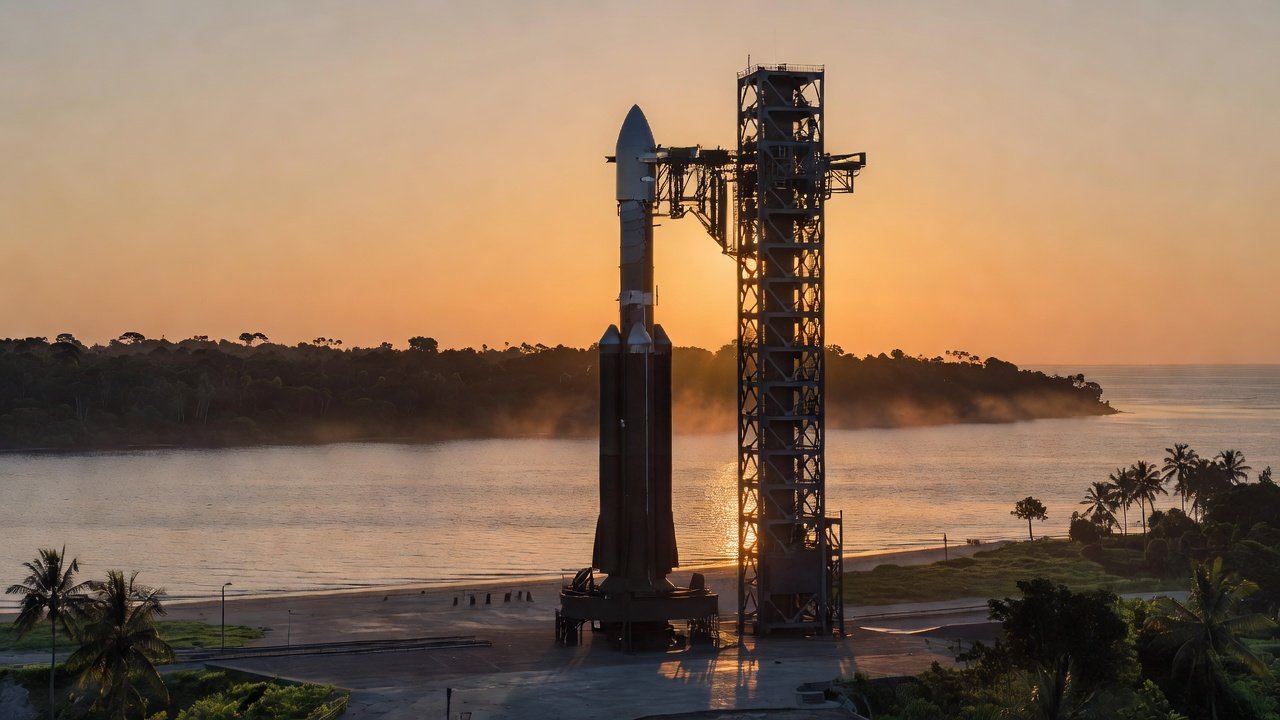
The premise of the title needs splitting in two. Against Falcon 9, the gap has not closed and is not going to. Against Vulcan, the comparison has turned upside down: Vulcan has been the vehicle struggling to fly in 2026, and Ariane 6 has had the better year. Neither fact makes Ariane 6’s ramp-up a finished story.
What Ariane 6 has actually flown in 2026
Through the end of August, Ariane 6 flew four missions in 2026, numbered VA267 to VA270:
- VA267, 12 February: the first Ariane 64 (four-booster) flight, carrying 32 Amazon Leo satellites under the long fairing.
- VA268, 30 April: a second Ariane 64 with another 32 Amazon Leo satellites.
- VA269, 17 June: the first Ariane 64 with the upgraded Block 2 boosters, carrying 36 satellites, reported as the heaviest payload the Ariane family has flown.
- VA270, 27 August: an Ariane 62 carrying the MTG-I2 weather satellite, the first Ariane 6 mission to geostationary transfer orbit. Arianespace’s launch release describes it as the fourth launch of the year.
The flight record before this year was four missions across 2025 (CSO-3, MetOp-SG A1, Sentinel-1D and a Galileo pair), after a maiden flight in July 2024 that ended with a partial failure of the auxiliary propulsion unit during the deorbit burn. So Ariane 6 has already matched its entire 2025 total inside eight months of 2026, and it has added a second configuration, a new fairing and a GTO capability along the way. Arianespace’s chief executive described the ramp-up as the fastest for any heavy-lift launcher.
That is real progress. It is also short of what the operator said it wanted.
The target and the arithmetic
After the Sentinel-1D launch in November 2025, Arianespace chief executive David Cavaillolès told reporters that six to eight Ariane 6 flights in 2026 “will be great,” and put the vehicle’s maximum capacity at nine to ten flights a year. He also said the pace was driven by customer demand rather than by technical limits on the vehicle.
Four flights by 27 August means two to four more would be needed in the remaining four months to land inside that range. Flights so far have been spaced roughly six to ten weeks apart. Holding that spacing would yield one or two more in 2026, for a total of five or six: inside the range only if the launches come quickly, and short of the top of it. We found no announced date for the next mission at the time of writing, so any year-end total remains a projection, not a manifest.
Schedule discipline matters here. A stated annual target is an operator ambition, not a launch contract, and the industry’s record on hitting first-year cadence targets is poor.
The Falcon 9 comparison
Falcon 9 is a different kind of number. Spaceflight Now’s coverage marked the 90th Falcon 9 flight of 2026 on 4 August and about 93 by 11 August, most of them Starlink missions. Ariane 6 had flown four times by then. That is a ratio above twenty to one, and it will not narrow this year or next.
Two things keep that comparison from being simply a scoreboard. First, Falcon 9’s cadence is built substantially on flying its own constellation, so it is partly a measure of SpaceX’s demand for its own launches. Ariane 6’s manifest has no equivalent captive customer. Second, the two vehicles do not compete for every payload. European institutional missions such as Galileo, Copernicus and the Meteosat series fly on European rockets largely because of Europe’s preference for European launchers on institutional payloads, not because Ariane 6 wins them on price or frequency.
Vulcan: the gap that inverted
ULA’s Vulcan was expected to be the vehicle Ariane 6 was chasing on the Amazon Leo manifest. It has not flown since its 12 February USSF-87 mission, when one of the four Northrop Grumman GEM 63XL solid rocket boosters suffered a nozzle failure. The mission still reached its target orbit, but the U.S. Space Force paused national security launches on Vulcan afterward. Northrop completed a static-fire test of the GEM 63XL on 15 April, and ULA has said it will resume flights with an Amazon Leo mission ahead of the government manifest. ULA had not published a return-to-flight date as of mid-September, according to reporting from the period.
The result is that Ariane 6 has delivered 100 Amazon Leo satellites in 2026 (32, 32 and 36) while Vulcan has delivered none. As of the last Atlas V Leo launch on 1 July, the constellation stood at 396 satellites out of a planned 3,236, so the launch providers still have a very long way to go, and Arianespace’s contract with Amazon was reported in late 2025 as covering 18 Ariane 64 flights, with the balance of the campaign running for years. That contract, not the institutional missions, is what is pulling Ariane 6 up its cadence curve.
The comparison should not be over-read. Vulcan’s grounding is a solid-motor problem, not a flaw in its core stage, and a return to flight will restore it as a serious competitor. Ariane 6’s advantage this year is partly a function of a rival’s absence.
What Block 2 changes, and what it does not
The Block 2 configuration adds longer P160C boosters carrying about 14 tonnes more propellant and an uprated Vinci upper-stage engine. Together they add about 2 tonnes of lift capability to low Earth orbit. On a 36-satellite Amazon Leo mission that shows up as four extra satellites over the 32 carried on the first two Ariane 64 flights.
What Block 2 does not change is the underlying economics. Ariane 6 is an expendable vehicle, and its cost per kilogram is set by manufacturing a new core stage, upper stage and boosters for every flight. The improvement is in mass per launch, not in the fundamental cost structure. Reusable competitors can reduce marginal cost on every flight. Ariane 6 can only improve its position by flying more often, spreading fixed production costs, and filling capacity on each mission.
Where the gap stands
Ariane 6 has closed the gap with Vulcan in 2026, but mainly because Vulcan is on the ground. It has not closed the gap with Falcon 9 and cannot on this timeline. The more useful test is internal: whether the vehicle reaches the top of its own six-to-eight target, and whether it then sustains nine or ten flights a year once Amazon Leo missions and European institutional payloads compete for the same launch pads and integration flow.
For a satellite operator weighing Ariane 6, the practical point is to treat the operator’s annual target as an upper planning bound, ask for the manifest position of your specific mission, and watch two dates in particular: the next Ariane 64 launch, and Vulcan’s return to flight.