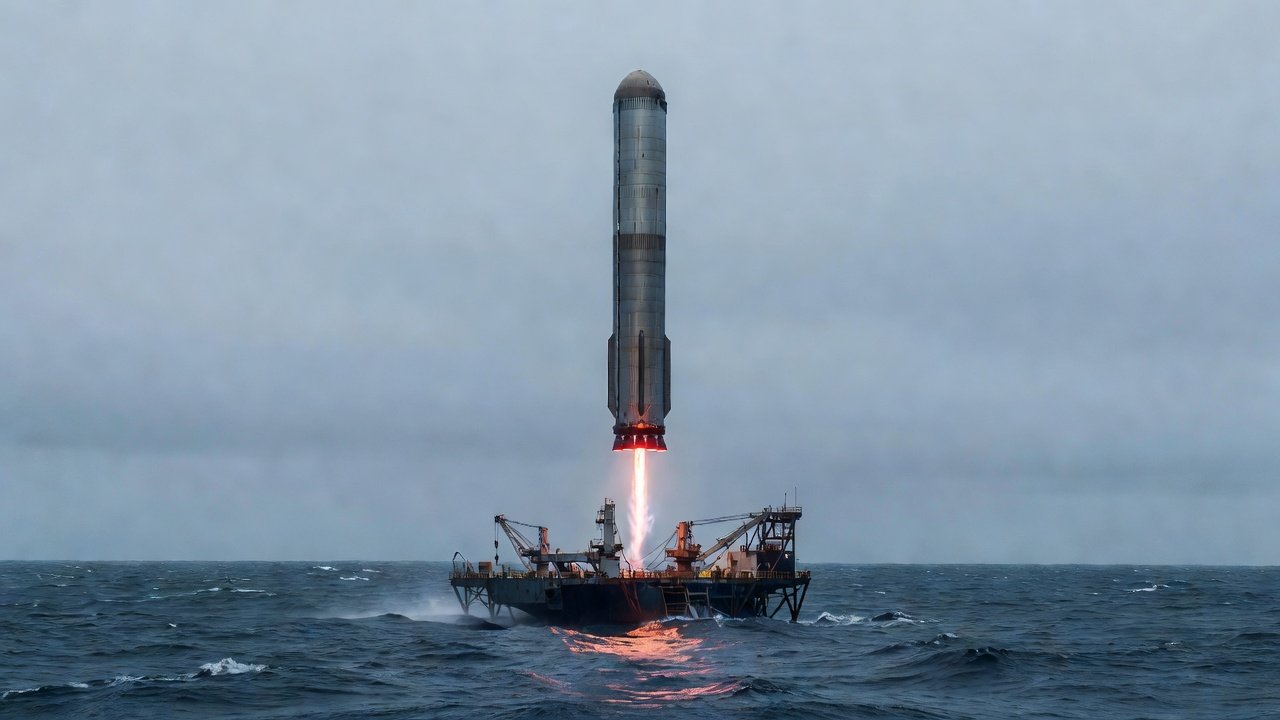
On 10 July 2026, at 0415 UTC, a Long March 10B lifted off from the Hainan Commercial Space Launch Site. Some minutes later its first stage descended over the South China Sea and was captured in a net strung across the deck of a waiting recovery vessel. It was the maiden flight of the vehicle, and it made China the second country to recover an orbital-class booster intact — and the first anywhere to do it into a net rather than onto landing legs.
That is a genuine achievement and it deserves to be described precisely, because the coverage around it has been unusually loose about what a recovery does and does not prove.
What was demonstrated
Three things, and they are not small.
Propulsive descent and terminal guidance to a moving maritime target. This is the hard part of booster recovery and always has been. Bringing a stage back through the atmosphere, relighting engines, and arriving at a specified point with the residual velocity and attitude within a capture envelope requires guidance, navigation and control performance that cannot be shortcut. Doing it on a first flight is notable; SpaceX required multiple attempts across 2015–2016 before its first successful droneship landing.
A net capture rather than a legged landing. This is a real architectural choice with real consequences. Landing legs are structural mass carried to orbit-adjacent altitudes and back, and they are mass that does nothing during ascent. Eliminating them improves payload performance. The trade is that the vehicle must now arrive inside a much tighter positional envelope, and the recovery infrastructure absorbs complexity the vehicle sheds.
Maritime recovery operations. Recovering at sea rather than returning to launch site preserves downrange velocity and therefore payload, at the cost of ship operations, weather dependence, and a longer turnaround.
What was not demonstrated
Recovery is not reuse. This distinction is the single most consistently blurred point in reusability coverage, and it matters more than any of the achievements above.
A recovered stage tells you the vehicle survived. It does not tell you the condition it is in, what refurbishment it requires, how long that takes, how much it costs, or how many times the airframe and engines can repeat the cycle before life limits are reached. SpaceX’s Falcon 9 economics did not become real when a booster first landed in December 2015; they became real over the following years as the company drove turnaround time down and flight counts per booster up. The landing was the prerequisite. The fleet leader statistics were the business case.
CASC has stated it expects the recovered stage to fly again before the end of 2026. That is the milestone that would actually matter, and it is worth reserving judgement on the timeline — announced refly dates in this industry have a poor record everywhere, not only in China. A refly within roughly six months of a first recovery would be an aggressive schedule by any operator’s historical standard.
Two further caveats belong in an honest assessment. The vehicle is partially reusable: the first stage is recovered, the second stage is expended, an architecture comparable to Falcon 9 and New Glenn rather than to a fully reusable system. And a single successful capture establishes that the capture is possible, not that it is repeatable. Recovery reliability is a statistic that requires flights to generate.
Where this sits in the vehicle family
Long March 10B is the partially reusable, single-stick derivative within the Long March 10 family, whose principal purpose is China’s crewed lunar programme. The relationship is worth understanding because it explains the investment.
A crewed lunar architecture requires high flight rates of a large vehicle, and high flight rates of an expendable large vehicle are prohibitively expensive. Reusability on the 10B is not primarily a commercial launch-market play; it is infrastructure for a national programme that needs cadence. This differs from the SpaceX case, where reuse was developed against a commercial manifest and the national-security and NASA work followed.
That difference has an implication for how quickly the capability matures. A vehicle flying a national programme’s manifest flies at the rate that programme requires, which historically is lower than a commercial constellation manifest demands. The learning curve on refurbishment is a function of flights, and flights are a function of demand.
The “second country” claim
The phrasing in most coverage — China becomes the second nation to recover an orbital-class booster — is accurate, and it is worth stating what it means and does not mean.
It means that recovery of an orbital-class first stage has now been demonstrated by exactly two countries, the United States and China. Within the US, both SpaceX and Blue Origin have done it, so the count of organisations is three and the count of nations is two. Anyone reading the national framing as a proxy for capability distribution should hold both numbers in mind.
It does not mean parity. SpaceX has flown and recovered boosters several hundred times, has individual boosters past twenty flights, and has driven the recovery operation to something close to routine. One capture on a maiden flight is the beginning of that curve, not a position on it.
What to watch next
Three concrete indicators over the next twelve to eighteen months will say more than any announcement.
Does the recovered stage refly, and when? A 2026 refly would be genuinely fast. A 2027 refly would be unremarkable and still significant.
What is the recovery success rate across the next five to ten flights? One capture is an existence proof. A run of captures is a capability.
What is the turnaround time on the second and third reflights? This is the number that determines whether reuse is an economic strategy or an engineering demonstration. It is also the number operators disclose least willingly.
Until those are answered, the correct description of 10 July is that China demonstrated it can bring a booster home. That is a hard problem and it is now solved. The problem that follows it is larger.
Sources: SpaceNews, “China becomes second country to recover orbital booster with Long March 10B” · CGTN, “China achieves reusable rocket breakthrough with Long March-10B” · Universe Today, “China Successfully Tests Reusable Long March-10B”