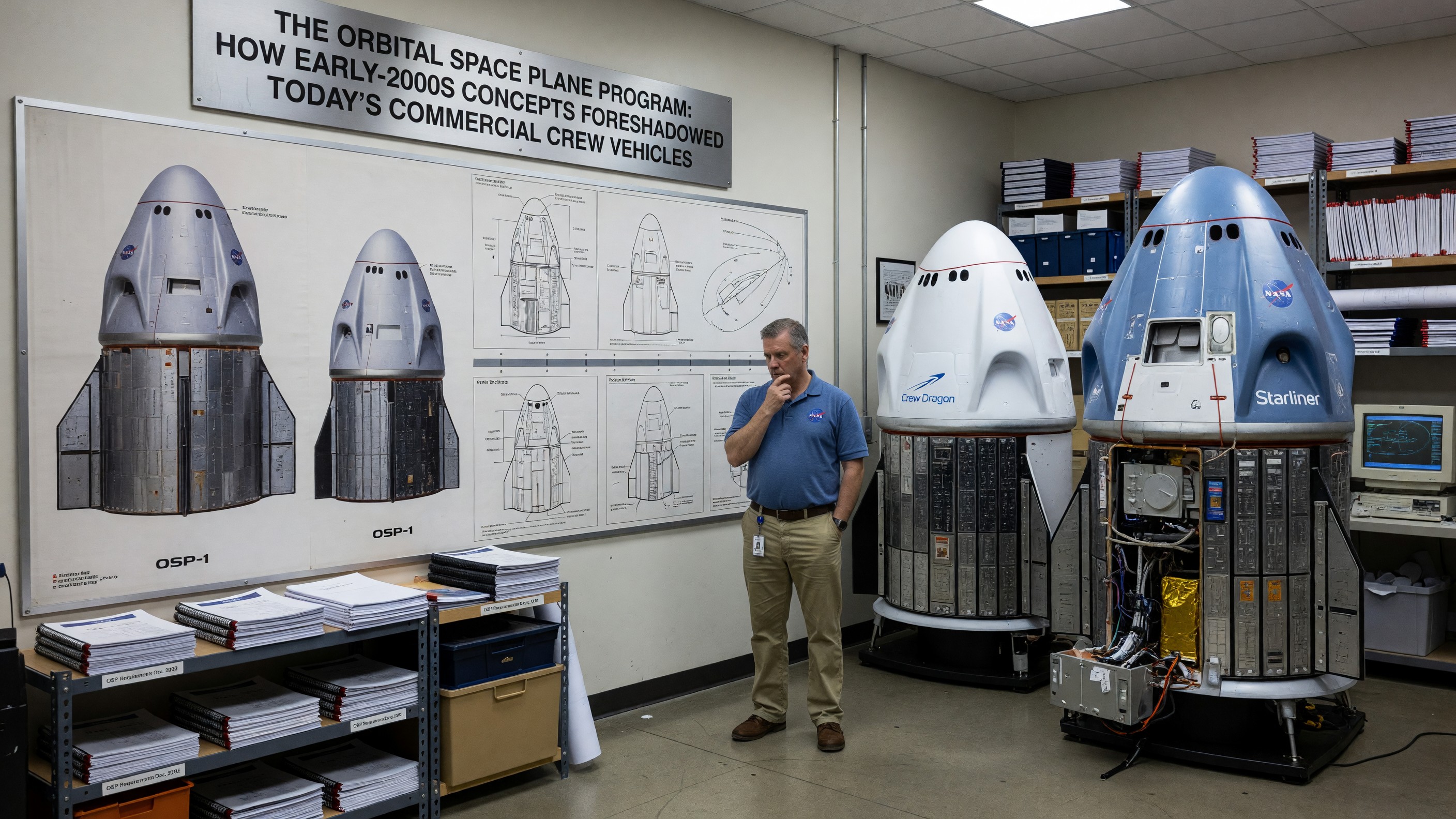
In the early 2000s, NASA was wrestling with a problem that would not fully resolve for nearly two decades: how to safely and routinely transport crew to and from the International Space Station without depending solely on the Space Shuttle. The Columbia accident in February 2003 made that question urgent. The agency’s response — a program called the Orbital Space Plane, or OSP — never produced flight hardware. But the requirements it laid out, the architecture choices it debated, and the operational logic it tried to satisfy describe with surprising precision what SpaceX’s Crew Dragon and Boeing’s Starliner actually deliver today.
The Orbital Space Plane is largely forgotten outside aerospace history circles. Yet anyone trying to understand why commercial crew vehicles look the way they do — capsules rather than spaceplanes, launched on existing boosters rather than dedicated vehicles, designed specifically for ISS crew rotation and rescue — benefits from understanding the program that first defined the operational need.
What the OSP Program Was
The Orbital Space Plane was a NASA initiative formally announced in late 2002 and developed under the broader Integrated Space Transportation Plan. Its mandate was to provide crew transport and crew rescue capabilities for the ISS, complementing the Shuttle in the near term and eventually serving as the primary U.S. crew transport vehicle for low Earth orbit.
The program was structured around two milestones. The first was a Crew Return Vehicle capability — a “lifeboat” that could carry the ISS crew home in an emergency. The X-38 program, which had been pursued in the late 1990s and cancelled in 2002, had attempted to fill this role with a lifting-body vehicle; OSP was, in part, a successor effort with a broader mandate. The second milestone was full crew transfer — a vehicle that could carry astronauts to the ISS and return them, replacing Shuttle-based crew rotation for routine missions.
The program’s requirements documents specified some surprisingly specific operational parameters. The vehicle had to carry at least four crew members to and from the ISS. It had to provide rescue capability for an ISS crew of four — meaning a docked lifeboat ready for emergency return. It had to be safer than the Shuttle by a meaningful margin, defined in probabilistic terms. And it had to be launched on an existing expendable launch vehicle — initially the Atlas V or Delta IV.
Read that requirements list again with two decades of hindsight, and what it describes is essentially what Crew Dragon and Starliner do today.
Capsule vs. Spaceplane
One of the most consequential debates within the OSP program was the choice between a capsule architecture and a lifting-body or winged spaceplane. The “space plane” in the program’s name implied the latter; the X-38 heritage and lifting-body research at NASA Langley and Dryden supported it; and the operational appeal of a runway landing was strong, especially for routine crew rotation.
Capsules, however, had several advantages that became increasingly clear as the program matured. They were simpler. They had a proven re-entry profile dating back to Apollo. They could splash down in water or land under parachutes with much less infrastructure than a runway landing required. And — most importantly for a vehicle that had to be launched on an existing expendable booster — they fit naturally on top of a rocket, where a winged vehicle would have introduced significant aerodynamic and structural complications.
By 2004, the OSP program had been folded into the broader Constellation program under President George W. Bush’s Vision for Space Exploration, which committed NASA to a capsule architecture — the Crew Exploration Vehicle, which eventually became Orion. The capsule decision made for Orion propagated into the Commercial Crew Program when it was conceived later in the decade. Both Crew Dragon and Starliner are capsule designs. The runway-landing spaceplane that the OSP program had initially imagined never flew under any program.
The closest active vehicle to the OSP spaceplane concept today is Sierra Space’s Dream Chaser, currently in development for cargo missions to the ISS. Dream Chaser is a lifting-body vehicle — the architecture OSP had originally considered. The fact that it remains in active development decades later suggests the spaceplane idea was not wrong; it was simply not the right choice for the specific constraints OSP was operating under in the early 2000s.
The Direct Lineage to Commercial Crew
The Commercial Crew Program, announced in 2010 and contracted in 2014, was not a direct continuation of OSP. By the time Commercial Crew was structured, NASA had been through Constellation’s cancellation, the Shuttle’s retirement, and a multi-year period of dependence on Russian Soyuz seats. But the requirements that Commercial Crew imposed on its industry partners closely mirrored what OSP had specified a decade earlier.
Crew of four to the ISS. Standby rescue capability for a docked ISS crew. Launch on existing expendable boosters — Falcon 9 for Dragon, Atlas V for Starliner. A safety standard meaningfully better than Shuttle. Autonomous docking capability. A re-entry and recovery profile compatible with existing range infrastructure.
The vehicles that NASA contracted — SpaceX’s Crew Dragon and Boeing’s Starliner — are both capsules, both launched on existing expendable rockets, both designed for crews of four, and both designed to serve as docked lifeboats during their ISS stays. Crew Dragon began operational service in 2020. Starliner completed its crewed flight test in 2024.
NASA’s Commercial Crew Program describes the contemporary program in language that, with minimal editing, could be applied to OSP. The continuity is not coincidental — many of the same NASA engineers and program managers who worked on OSP carried forward the same requirements thinking into Constellation, and ultimately into Commercial Crew.
What OSP Got Right, and What It Missed
OSP correctly identified that the ISS needed a dedicated crew vehicle separate from the Shuttle, and that this vehicle needed to be capsule-based, launched on an existing expendable rocket, and capable of both rotation and rescue missions. All of that turned out to be correct.
What OSP missed — and what NASA generally missed in the early 2000s — was the commercial procurement model that would eventually deliver the program. OSP was structured as a traditional NASA development effort, with the agency owning the vehicle design and contracting industry to build to specification. The Commercial Crew Program’s fixed-price, milestone-based, industry-owned-design approach produced vehicles in a way OSP’s contracting structure probably could not have.
The other thing OSP missed was reusability. The program’s specifications treated the vehicle as essentially expendable, with occasional refurbishment between flights. Crew Dragon, by contrast, has demonstrated significant reuse of capsules across multiple missions — a capability that was not part of OSP’s design baseline.
The Heritage Worth Preserving
NASA’s institutional memory of programs like OSP matters more than program continuity. The requirements engineering, the architecture trade studies, and the operational concept-of-operations work that went into OSP did not disappear when the program was cancelled. It informed Constellation, informed Commercial Crew, and continues to inform planning for the post-ISS commercial low Earth orbit destinations that NASA is now funding.
The lesson is that operational requirements have a longer life than programs. A program can be cancelled, restructured, or rolled into another effort. The underlying need — safe and routine crew transport to a destination in low Earth orbit — persists, and the vehicles that eventually satisfy it tend to look a lot like what earlier programs specified, even when those programs never flew.
The Orbital Space Plane never reached the launch pad. Crew Dragon and Starliner did. The lineage between them is real, even if the program names have changed.
Frequently Asked Questions
Q: What was the Orbital Space Plane program? A: OSP was a NASA program formally announced in late 2002 to develop a crew transport and crew rescue vehicle for the International Space Station. It was rolled into the Constellation program in 2004 and never produced flight hardware.
Q: Why didn’t OSP fly? A: The program was folded into the broader Constellation program under the Vision for Space Exploration in 2004. Constellation pursued a different vehicle — Orion — and OSP’s specific requirements were absorbed into successor programs rather than carried forward as a discrete effort.
Q: How does OSP relate to Crew Dragon and Starliner? A: The operational requirements OSP defined — crew of four to the ISS, rescue capability for a docked crew, launch on existing expendable boosters, capsule architecture — closely match what Crew Dragon and Starliner actually deliver today through the Commercial Crew Program.
Q: Was OSP supposed to be a capsule or a spaceplane? A: The program initially considered both. By 2004 the architecture had largely converged on a capsule, which is the path NASA’s subsequent programs followed.
Q: Is there any active spaceplane in NASA’s portfolio today? A: Sierra Space’s Dream Chaser is the closest active vehicle to the original OSP spaceplane concept, being developed for ISS cargo missions.
Q: Why does OSP matter if it never flew? A: Because the requirements it defined shaped how NASA later structured Commercial Crew. The program is an example of institutional knowledge surviving a cancellation and informing the design of the program that eventually delivered the capability.