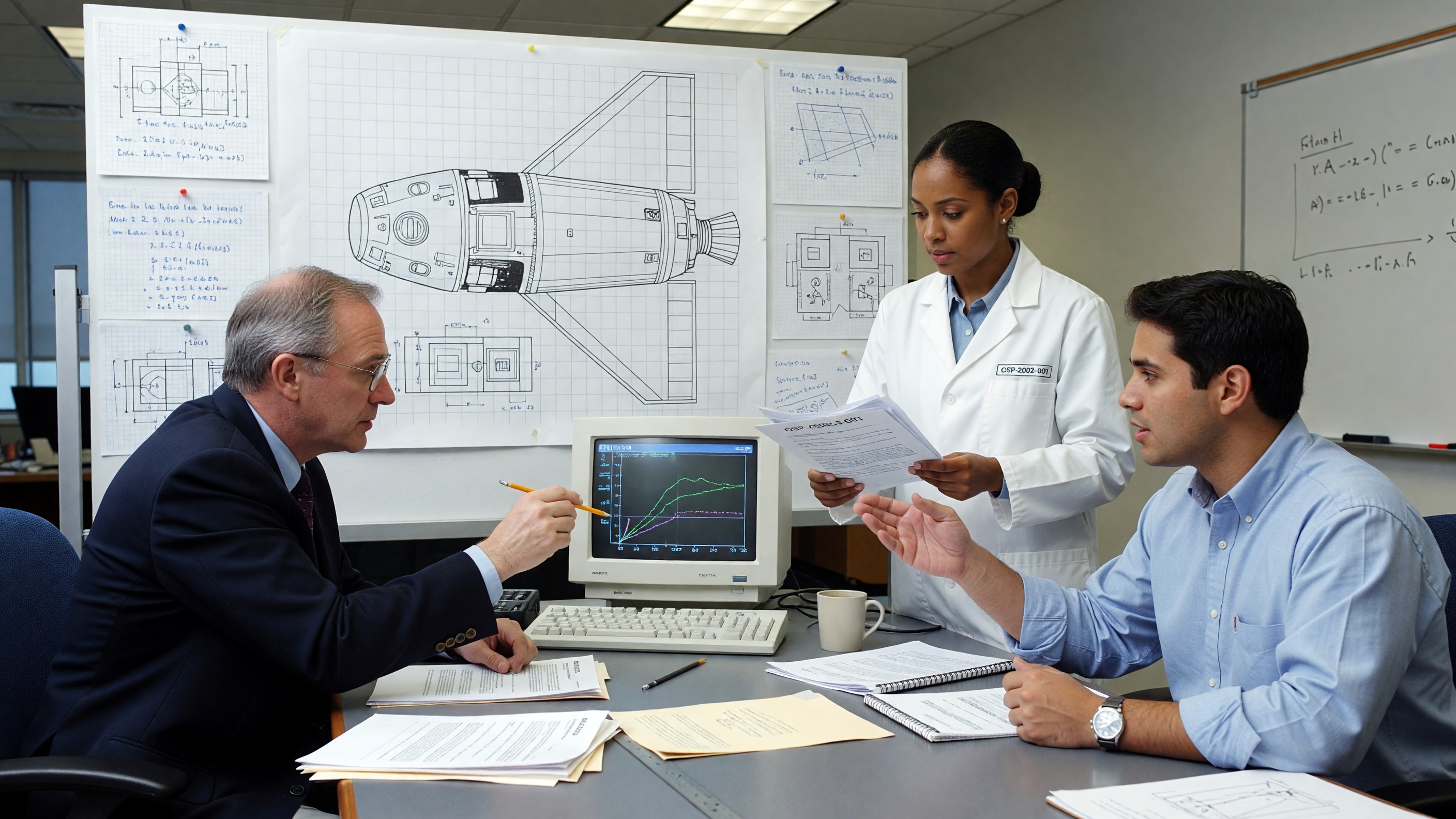
The Orbital Space Plane program is often dismissed as a brief detour between the Space Launch Initiative and the Vision for Space Exploration. That framing undersells its importance. The requirements NASA wrote for OSP in 2002 represented the first time the agency rigorously defined what a post-Shuttle crew vehicle actually had to do. Those requirements, formalized in a Level 1 requirements document and refined through 2003, would echo through the Constellation program, the Crew Exploration Vehicle, and ultimately the Commercial Crew Program’s Statement of Work — sometimes nearly verbatim.
Understanding OSP’s requirements is therefore not an exercise in archaeology. It is a way of understanding why Crew Dragon and Starliner look the way they do.
The Core Mission Set
NASA’s OSP requirements were organized around two primary missions: crew transfer to the International Space Station and crew rescue from the ISS in the event of an emergency. A handful of secondary missions — contingency cargo, station logistics support — appeared in supporting documents, but the dominant design drivers were transfer and rescue.
The headline numbers were straightforward:
- Crew of at least four
- Capable of docking with the ISS
- Launched on an expendable launch vehicle
- Capable of remaining attached to the ISS for at least six months in a quiescent rescue posture
- Designed to return crew safely from ISS orbit to a designated landing site
- Safety improvements significantly beyond Shuttle baseline
Each of these constraints created architectural consequences that were not obvious on first reading.
Crew Of Four
The four-person crew requirement seems like a routine choice, but it was driven by a specific operational reality: the ISS, when fully crewed under the planned configuration, would carry six or seven occupants. A rescue vehicle capable of carrying four crew, combined with the Soyuz already at the station, would cover full-station evacuation. NASA’s International Space Station program documentation discusses this multi-vehicle rescue posture in detail.
A crew of four also pushed the vehicle into a size class that ruled out the smallest capsule concepts. It forced a habitable volume large enough to accommodate four pressure-suited occupants in seated couches with appropriate stroke for landing loads, plus avionics, life support, and a reasonable interior layout for a multi-day transfer mission. That, in turn, drove vehicle mass, which drove launch vehicle selection.
The Rescue Function As Dominant Driver
The single most important — and most under-appreciated — feature of the OSP requirements was that the rescue mission, not the transport mission, was the dominant design driver. A transport vehicle needs to operate for a few days. A rescue vehicle needs to remain docked and dormant at the ISS for months, in a thermal and radiation environment that is hostile to electronics and propellants, then come back to life on demand and execute a deorbit and entry without prior crew preparation.
The implications cascaded throughout the design space:
- Power and thermal: The vehicle had to support extended dormant operations, implying robust passive thermal management and a power architecture compatible with long quiescent periods
- Propellant compatibility: Propellants had to be storable for months without significant degradation, effectively eliminating cryogenics for the service module
- Avionics survivability: Electronics had to tolerate long radiation exposure and remain reliable after extended cold soak
- Reliable activation: The vehicle had to power up and execute a deorbit reliably even after months of dormancy, with crew that might be incapacitated or injured
These constraints pushed designers toward conservative, heritage-based subsystems. They rewarded simplicity over performance. They also made the rescue requirement disproportionately expensive — a vehicle designed only for transport would have been significantly cheaper.
Expendable Booster
The decision to baseline an expendable launch vehicle for OSP was a deliberate retreat from SLI’s reusability ambitions. By 2002, NASA had concluded that fielding a new reusable booster on the OSP timeline was infeasible. The expendable booster baseline — typically EELVs like the Atlas V and Delta IV, both of which were entering service in that period — let the program focus its risk budget on the crew vehicle itself.
This decision shaped the vehicle in two important ways. First, it constrained vehicle mass to what the existing or near-term EELVs could lift to ISS orbit with adequate margin. Second, it forced early attention to human-rating an existing expendable booster — a problem that would consume enormous engineering effort during the Commercial Crew era for both the Atlas V/Starliner and Falcon 9/Crew Dragon combinations.
The Architectural Competition
The OSP requirements set off a vigorous architectural debate inside NASA and among industry partners. Three families of concept were seriously studied:
Capsule concepts. Ballistic or semi-ballistic capsules in the Apollo or Soyuz tradition, returning under parachute to a land or water landing. These minimized development risk, fit within EELV lift capacity comfortably, and benefited from extensive heritage data. They had limited cross-range and modest crew comfort.
Lifting body concepts. Designs derived from the HL-20 and X-38 lineage, offering meaningful cross-range and runway-friendly landing profiles while still being launched atop an expendable booster. These were favored by parts of the human spaceflight community that valued operational flexibility, particularly the ability to return to a designated runway from a wider range of orbital positions.
Winged vehicles. Smaller, more aircraft-like concepts that promised even more flight-like landing operations at the cost of significantly higher development risk, weight penalties, and thermal protection complexity.
By 2003, internal NASA analysis was converging on a capsule baseline. The combination of mass margin, development risk, and rescue-function suitability favored the simpler shape. When the program was absorbed into the Crew Exploration Vehicle and ultimately into Orion, that convergence was effectively cemented.
How These Requirements Echo In Commercial Crew
What is striking about the OSP requirements, in retrospect, is how directly they reappear in NASA’s Commercial Crew Program. The Commercial Crew Program reflects the same core mission set: crew of four, ISS docking, expendable booster, six-month dormant rescue posture, safety targets significantly beyond Shuttle. The language has been modernized, the contracting model has been transformed, and the responsibility for vehicle design has shifted from NASA to industry — but the requirement skeleton is recognizably the same.
This is not an accident. The teams who wrote the Commercial Crew Statement of Work included engineers who had worked on OSP. The mission profile — ISS rotation flights with rescue capability — had not changed. The trade space had been thoroughly explored once already, and there was no reason to redo it.
Both Crew Dragon and Starliner reflect this lineage. Both are capsules, not lifting bodies. Both are sized for a crew of four for NASA missions. Both are designed for six-month dormancy at the ISS. Both rely on EELV-class expendable boosters, even though one of those boosters is partially reusable in its first stage. The architectural pattern was set in 2002.
What OSP Failed To Settle
The requirements were stronger than the program around them. OSP did not survive long enough to settle several important questions:
- Whether the vehicle should land on land, on water, or be runway-capable
- How crew abort would be architected for an EELV
- Which booster, specifically, would be human-rated first
- How the contracting model should balance fixed-price and cost-plus elements
Each of these questions was left to subsequent programs to answer. Constellation and Orion took up the abort and landing questions. Commercial Crew settled the contracting model question, decisively, in favor of fixed-price service contracts.
Frequently Asked Questions
Q: What was the Orbital Space Plane? A: OSP was a NASA program, active primarily from 2002 to 2004, intended to develop a crew transport and rescue vehicle for the International Space Station. It was carved out of the broader Space Launch Initiative when NASA concluded that a full second-generation reusable launch vehicle was infeasible on the desired timeline.
Q: Did the Orbital Space Plane ever fly? A: No. OSP did not progress beyond requirements definition and conceptual design before being absorbed into the Crew Exploration Vehicle effort under the Vision for Space Exploration. The CEV in turn became Orion.
Q: Why did NASA require a crew of four? A: The four-person crew requirement was driven by ISS rescue needs. A vehicle of that capacity, combined with the Soyuz already docked at the station, would allow full evacuation of an ISS expedition crew under emergency conditions.
Q: Why did rescue drive the design more than transport? A: A transport vehicle operates for days; a rescue vehicle must remain dormant at the ISS for months and then activate reliably on demand. The thermal, radiation, propellant storage, and avionics dormancy constraints associated with six-month standoff at the station drove far more design margin than the relatively short active transport phase.
Q: How do OSP requirements relate to Commercial Crew? A: The OSP requirements set is the direct intellectual ancestor of the Commercial Crew Program’s vehicle requirements. The crew-of-four, ISS-docking, expendable-booster, six-month rescue baseline established under OSP reappears, with modernized language, in the Commercial Crew Statement of Work that Crew Dragon and Starliner were ultimately designed to.