For most of the space age, the launch vehicle was a disposable object. A rocket lifted a payload, separated, and fell back to Earth — or into the ocean — never to be used again. Each flight required a brand-new vehicle, and the economics of spaceflight were shaped accordingly: high marginal costs, low flight rates, and a launch market that grew only as fast as the supply of new hardware would permit.
That assumption is no longer the default. By mid-2024, reusable launch vehicle architecture has moved from a contested theory to a demonstrated operational reality, at least for one company and one stage. The implications are still working their way through the rest of the industry, and the path forward is neither uniform nor settled.
What “Reusable” Actually Means in 2024
It is worth being precise about what has been proven and what has not. A reusable launch vehicle is not a single concept — it is a stack of design and operational choices that vary by stage, by recovery method, and by refurbishment requirements.
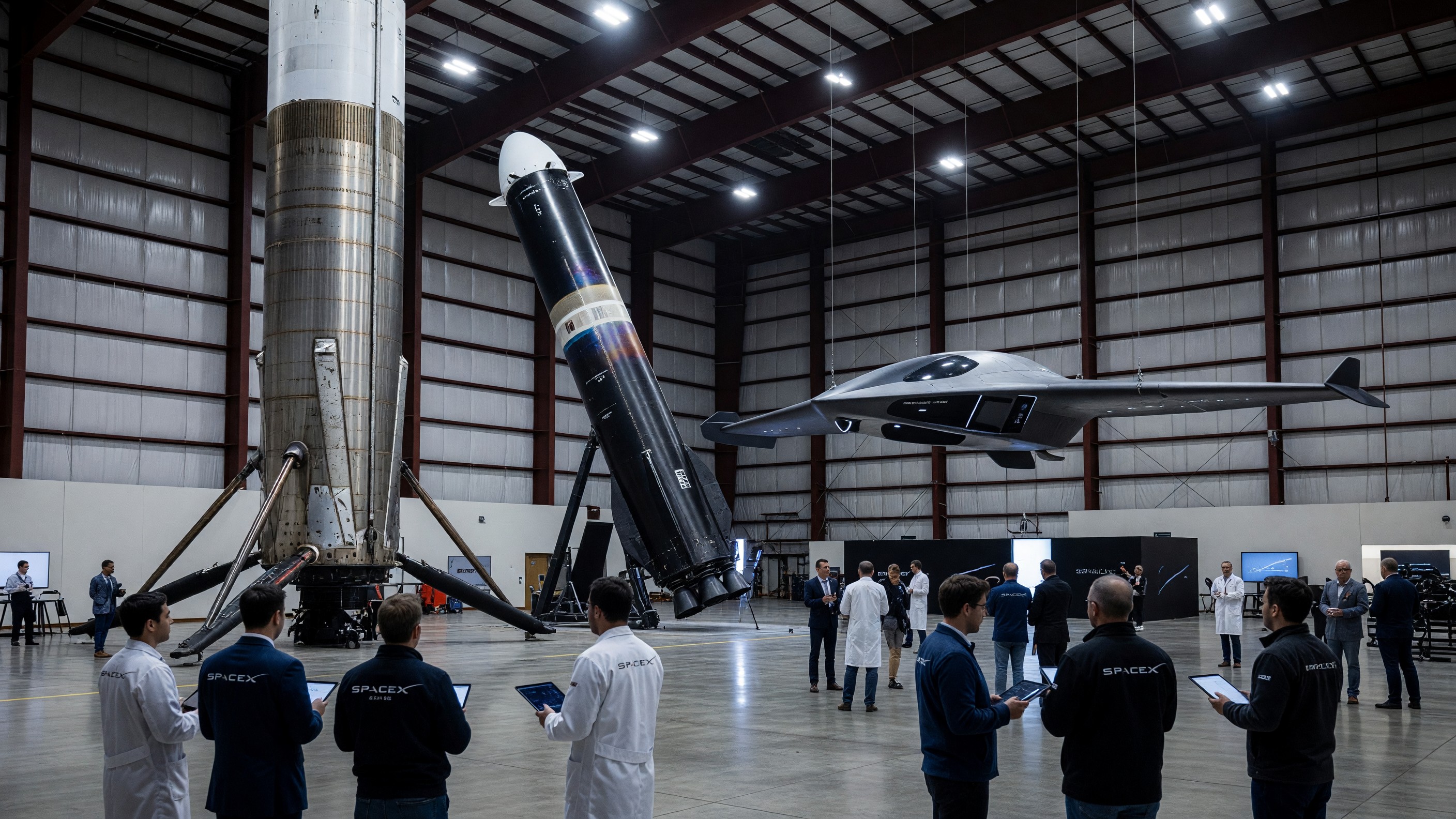
SpaceX’s Falcon 9 first stage is the canonical example of demonstrated orbital-class reusability. The booster performs a boostback or downrange burn after stage separation, re-enters the atmosphere using grid fins and engine relight, and lands either on a drone ship in the Atlantic or Pacific or on a return-to-launch-site pad at Cape Canaveral or Vandenberg. As of mid-2024, several individual boosters have flown more than 20 missions, and the company has standardized turnaround in weeks rather than months for high-cadence cores. The full picture of Falcon 9’s flight history and reuse milestones is published by SpaceX and updated regularly.
The Falcon 9 second stage, by contrast, is not reused. It deorbits or is left in orbit depending on mission profile. SpaceX has periodically discussed approaches to second-stage recovery — including catch concepts and heat-shield experiments — but none have flown operationally on Falcon. Second-stage reuse is being pursued instead through the Starship program, which is a clean-sheet architecture rather than a Falcon upgrade.
Fairing recovery sits in a middle category. SpaceX recovers fairing halves from the ocean using vessels equipped to fish them out, dries and inspects them, and refurbishes them for reflight. This is not the propulsive landing that the boosters perform — it is a softer parachute-and-splashdown approach — but the fairings are routinely reused, and the economics are meaningful given that a fairing set is a multi-million-dollar component.
What Falcon 9 Proved
The proof points from the Falcon program are now numerous enough to be treated as engineering facts rather than aspirational claims.
First: orbital-class boosters can survive the thermal and structural loads of re-entry repeatedly. The Merlin engines that fly today are flight-proven across dozens of missions on individual hardware sets, and the turbopumps, combustion chambers, and avionics have demonstrated the kind of cycle life that early skeptics doubted was achievable without extensive teardown between flights.
Second: vertical propulsive landing is a tractable control problem. The grid fins, throttleable engines, and guidance algorithms required to land a slender booster on a moving drone ship at sea — or precisely on a concrete pad ringed with infrastructure — have moved from extraordinary to routine. Landing failures are now rare enough to be newsworthy.
Third: refurbishment cost is materially lower than build cost. SpaceX has not published a complete unit-economics breakdown, but the company’s pricing — and its dominant share of the commercial launch market — suggests that the marginal cost per flight has dropped substantially compared to expendable equivalents.
Fourth: cadence scales. The combination of multiple boosters in the active fleet, two coastal launch sites, and two drone ships in service supported a launch rate in 2023 of nearly 100 missions, with mid-2024 tracking toward a higher annual total. No previous launch system has demonstrated this kind of throughput.
What Is Still Being Developed
Starship is the obvious case of an architecture that is reusable by design but not yet operationally reusable. The vehicle’s third integrated flight test, conducted in March 2024, was a significant step: the booster performed a controlled splashdown in the Gulf of Mexico, and the upper stage reached a suborbital trajectory before being lost during re-entry. The fourth integrated flight test is upcoming as of this writing. SpaceX’s Starship program page describes the intended architecture: full and rapid reusability of both stages, with the booster caught by the launch tower’s “chopstick” arms and the upper stage returning to a similar catch infrastructure.
None of that had been demonstrated as of mid-2024. The booster catch had not been attempted. The upper stage had not survived re-entry. The propellant-transfer architecture required for the lunar lander variant had not been tested in orbit. These are real engineering challenges, and the program’s timeline remained uncertain.
Rocket Lab’s Electron recovery program is the other significant industry attempt at reusability, scaled to a small launch vehicle. The company experimented with parachute recovery — splashing the first stage down in the ocean — and previously attempted helicopter mid-air capture. Rocket Lab has recovered hardware multiple times and reflown some engines, but had not yet completed a full reflight of a recovered booster. Details of the approach are documented on the Rocket Lab Electron page. Rocket Lab has also signaled that its next-generation Neutron vehicle, currently in development, is designed for reusability from the outset.
The Industry Shift
The most consequential change of the past several years is not a particular technology demonstration but a shift in default assumptions. New launch vehicles being designed today are, with rare exceptions, designed with reuse in mind.
Blue Origin’s New Glenn is intended to recover its first stage on a downrange vessel. ULA’s Vulcan Centaur, while expendable in its current configuration, has a long-term concept called SMART reuse that would recover the engine section. China and several European efforts have publicly committed to recoverable boosters. Even small-launch entrants who once positioned themselves against the recovery overhead are revisiting the question.
The reason is competitive. A launch market in which one provider can offer flight-proven Falcon 9 missions at prices substantially below expendable competitors has reset the baseline. Customers who once accepted that a launch cost what a launch cost now have a reference point.
It is worth noting what has not changed. National security and high-energy missions still sometimes require expendable configurations, either because the trajectory does not leave enough propellant margin for booster recovery or because the customer is willing to pay for it. Some payloads still ride on expendable vehicles for scheduling or political reasons. And for very small payloads, the economics of dedicated reusable launch are not yet compelling — the rideshare market on Falcon 9’s Transporter missions has absorbed much of that demand.
What to Watch in the Next Year
Three things are worth tracking. The first is whether Starship achieves a complete demonstration of upper-stage re-entry and landing — the milestone that would distinguish it as the first fully reusable orbital architecture. The second is whether Rocket Lab successfully reflies a recovered Electron booster, which would be the first non-SpaceX orbital-class reuse. The third is the pace of new entrants — New Glenn in particular, which was approaching its inaugural flight.
The reusable era is no longer hypothetical. The question is no longer whether reuse is possible, but how many providers can do it, how quickly, and at what cost.
Frequently Asked Questions
Q: Is the Falcon 9 fully reusable? A: No. The Falcon 9 first stage and the payload fairings are recovered and reflown, but the second stage is expended on every mission. Full reuse is a goal of the Starship program, not Falcon.
Q: How many times has a single Falcon 9 booster flown? A: As of mid-2024, several individual boosters have flown more than 20 missions. SpaceX has progressively raised the certified life of the hardware.
Q: How does Rocket Lab’s recovery approach differ from SpaceX’s? A: Rocket Lab’s Electron is much smaller than Falcon 9 and uses parachute-assisted ocean splashdown rather than propulsive landing. The company has recovered hardware and reflown engines but had not yet completed a full booster reflight by mid-2024.
Q: Is reuse always cheaper? A: Not necessarily on a per-flight basis for any individual mission, but at scale and across a fleet, reusable boosters have demonstrably lowered marginal launch costs. The economics improve as flight cadence rises and refurbishment cycles shorten.
Q: What is the biggest unproven element of Starship’s reusability? A: Upper-stage re-entry and landing. The booster had been recovered in a controlled splashdown, but the upper stage had not survived re-entry. The “chopstick” catch at the launch tower also remained undemonstrated as of mid-2024.
Q: Will expendable rockets disappear? A: Not entirely, at least not soon. Specific national security missions, high-energy trajectories, and some legacy contracts still use expendable configurations. But for the bulk of the commercial market, reusability is becoming the default rather than the exception.