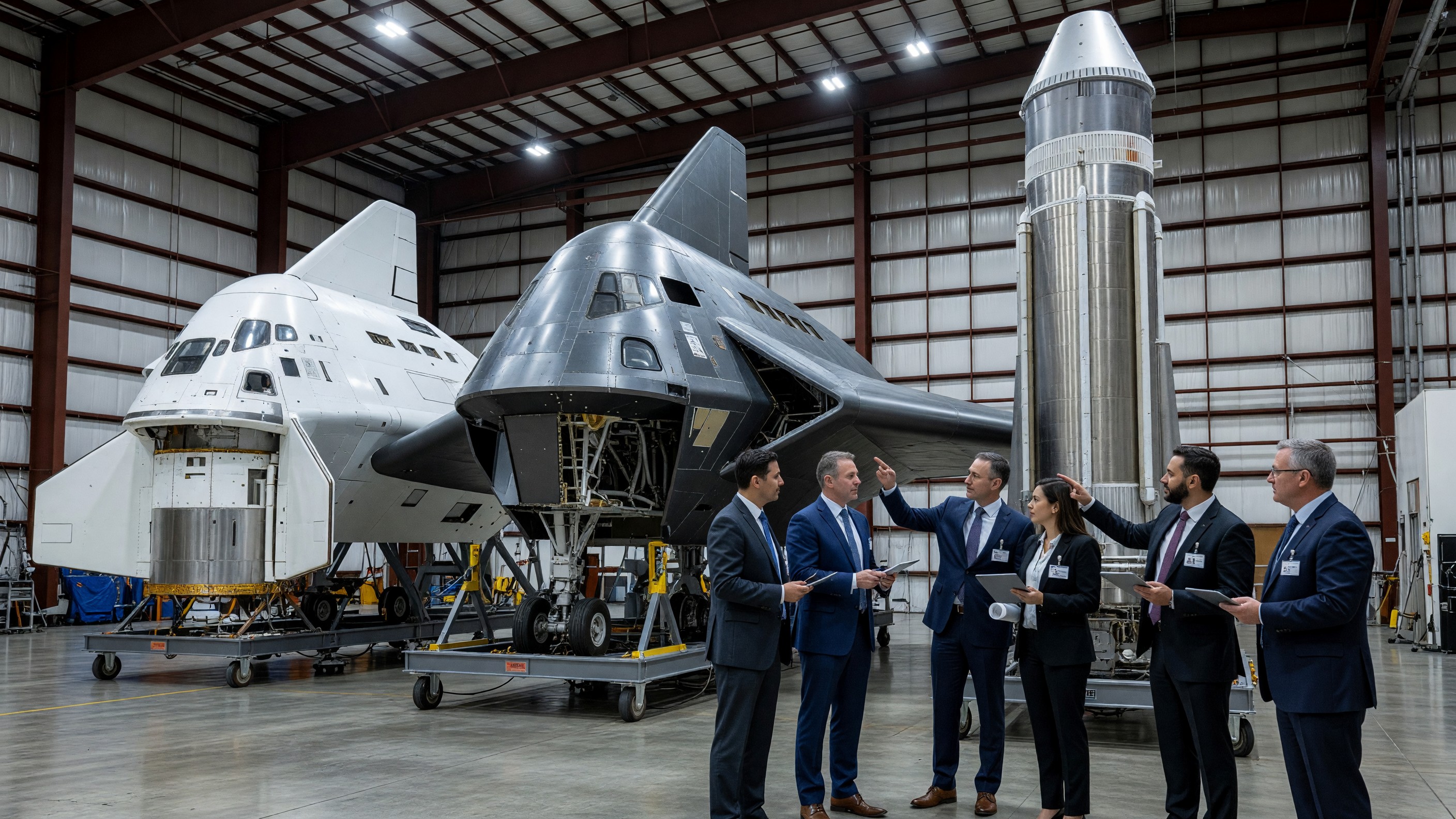
When NASA awarded the Space Launch Initiative’s architecture definition contracts in 2001 and 2002, three industry teams emerged with serious roles: Boeing, Lockheed Martin, and a partnership led by Northrop Grumman with Orbital Sciences. Each team approached the problem of a second-generation reusable launch vehicle from a different intellectual starting point. Each carried forward decades of prior heritage — and rivalries — into a program that, in retrospect, was both a culmination of late-20th-century launch vehicle design thinking and a transitional moment toward something genuinely new.
Two decades later, the legacy of those contracts is not the vehicles they proposed, which were never built. It is the workforce, the technical knowledge, and the contracting culture that emerged from the competition.
The Boeing Approach
Boeing’s SLI work was led primarily out of Seal Beach, California, with substantial participation from Huntington Beach and Houston. The Boeing team’s institutional heritage included the Saturn V S-IC stage, the Space Shuttle orbiter (through the McDonnell Douglas and Rockwell heritage absorbed in the late 1990s), and Delta II and Delta IV launch vehicle development.
That heritage shaped Boeing’s architectural instincts. The team gravitated toward concepts that leveraged existing manufacturing capability, existing engine technology, and existing operations infrastructure. Their proposed architectures tended to feature large reusable boosters with conventional staged-combustion engines, expendable upper stages where reusability did not pay back, and significant continuity with Shuttle-era ground operations.
The Boeing team’s strength was integration. They knew how to manage a program with thousands of subcontractors, how to interface with NASA’s center structure, and how to navigate the procurement system. Their challenge was that the same institutional muscle memory that made them effective program managers also pulled their designs back toward what they already knew how to build.
The Lockheed Martin Approach
Lockheed Martin’s SLI work was anchored in Denver, with heritage drawn from the Titan family, the Atlas family (which Lockheed had inherited through prior acquisitions), and the X-33 program — an earlier reusable launch vehicle effort that had been cancelled in 2001 after running into significant problems with its composite hydrogen tank.
The X-33 experience left Lockheed Martin’s team with a mixed inheritance. They had deep technical knowledge of single-stage-to-orbit concepts, aerospike engines, and composite cryogenic structures. They also had institutional memory of how badly those technologies could go wrong when integrated into a single vehicle. The Lockheed Martin SLI architectures tended to be more conservative than the X-33’s, leaning toward two-stage configurations and more conventional engine choices, while preserving some of the lifting body and aerodynamic insights from the X-33 lineage.
Lockheed Martin’s particular strength was systems engineering depth on the crew safety and abort problem. The team’s work on launch escape and abort architecture would later prove directly relevant to Orion, which Lockheed Martin became the prime contractor for several years after SLI’s cancellation.
The Northrop Grumman / Orbital Partnership
The Northrop Grumman team — at the time still operating with TRW heritage from a recent acquisition — partnered with Orbital Sciences (then an independent company, decades before its eventual merger into Northrop Grumman itself) to bring a different perspective to the SLI competition. Their architectural concepts tended to be more willing to depart from Shuttle-derived thinking.
Orbital Sciences’ heritage in small launch vehicles, with Pegasus and Taurus, gave the team a sensitivity to operational cost and turnaround that the larger primes sometimes lacked. TRW’s propulsion heritage — particularly in pintle injector engines, the basic technology underlying SpaceX’s Merlin — added a distinctive propulsion perspective. Northrop Grumman’s experience in advanced aircraft programs contributed structures and integration capabilities.
The team’s proposed architectures explored a wider trade space than the other two, including configurations that mixed reusable first stages with expendable elements optimized for cost rather than reusability.
Three Distinct Architectural Philosophies
It is worth being careful about the architectural specifics, because NASA’s SLI was deliberately structured to keep the trade space open, and no team was asked to commit to a single configuration. What is fair to say is that three distinct philosophies emerged from the three teams:
- Boeing favored evolutionary architectures that leveraged existing engine and manufacturing heritage, with reusable elements where the payback was clearest
- Lockheed Martin brought lessons from X-33 toward more conservative two-stage configurations with strong emphasis on crew safety architecture
- Northrop Grumman / Orbital explored a wider trade space, including configurations optimized more aggressively for cost and operational simplicity
NASA’s role was to fund the exploration of these alternatives, not to pick a winner. That was both the program’s intellectual strength and, ultimately, a contributor to its political vulnerability — without a single program-of-record vehicle to defend, SLI was easier to cancel.
The Contracting Model
SLI’s contracting structure was an experiment. NASA used a mix of cost-plus contracts for the architecture definition work and was beginning to explore more outcome-based approaches for component demonstrations. The fixed-price-versus-cost-plus debate, which would later become central to the Commercial Crew Program’s identity, was actively in motion during SLI.
The traditional NASA model — cost-plus contracts with detailed government oversight — had clear advantages for early technology work where requirements were genuinely uncertain. It also had well-known drawbacks: limited incentive for contractor cost discipline, complex and expensive contract administration, and tendency toward requirements creep. SLI sat in the middle of this tension. The architecture definition work was largely cost-plus, but NASA was actively interested in moving more risk to contractors as concepts matured.
That interest informed the design of the Commercial Orbital Transportation Services program that emerged later in the decade. The COTS program explicitly references the institutional lessons learned in earlier launch vehicle efforts, including SLI.
What Happened To The Workforce
The most consequential legacy of the SLI contractor competition was not the vehicles, which were never built, but the engineers, who continued to work in the launch industry for decades afterward.
When SLI was wound down in 2003 and 2004, the workforce dispersed but did not disappear. Boeing’s launch vehicle workforce flowed into the Crew Exploration Vehicle competition — which Lockheed Martin won, becoming Orion’s prime — and into United Launch Alliance, the Boeing/Lockheed joint venture formed in 2006 to consolidate the EELV business. Lockheed Martin’s SLI workforce moved heavily into Orion. Northrop Grumman’s portion eventually consolidated under Northrop Grumman Innovation Systems through subsequent corporate restructuring.
A meaningful subset of these engineers also moved to commercial launch providers. SpaceX, in particular, recruited heavily from the traditional aerospace primes throughout the mid-2000s. While each engineer’s individual story is their own, the aggregate effect is that the engineering workforce that had been built up around SLI’s reusable launch vehicle concepts ended up dispersed across both the traditional prime contractors and the new commercial entrants — feeding both halves of the current market.
The Continuity To Today
The current launch market is often described in terms of a sharp break: legacy primes on one side, new commercial entrants on the other. The reality is more continuous than that framing suggests.
Boeing’s role in Commercial Crew, with Starliner, traces a recognizable institutional line back through CST-100 development, EELV experience, and SLI-era reusable launch vehicle work. Lockheed Martin’s role as Orion prime traces a similar line through X-33, SLI, and CEV. Northrop Grumman’s current role in solid rocket motor production, in defense launch, and in Antares traces through Orbital Sciences and through the SLI-era Northrop/Orbital partnership.
Even SpaceX and Blue Origin, despite their commercial origins, are not disconnected from this lineage. They hire engineers who trained on these programs. They use propulsion concepts — pintle injectors, hydrocarbon staged combustion — that were studied or matured during the SLI/NGLT era. Their operational philosophies depart from those of the legacy primes, but their technical inheritance does not.
The current launch market is, in a real sense, the long-run output of the SLI contractor ecosystem. The vehicles are different. The companies have evolved. The engineers, the knowledge, and the contracting models trace back.
Frequently Asked Questions
Q: Which contractors won Space Launch Initiative architecture contracts? A: Boeing, Lockheed Martin, and a Northrop Grumman / Orbital Sciences partnership received major architecture definition contracts under SLI, with substantial subcontractor and propulsion company participation across the program.
Q: Did any of the SLI vehicle architectures get built? A: No. SLI was a study and technology maturation program, not a vehicle development program. None of the proposed architectures progressed to integrated vehicle hardware before the program was wound down in 2003 and 2004.
Q: How did SLI contractor relationships influence Commercial Crew? A: Both Commercial Crew prime contractors — Boeing and SpaceX — drew on workforce, propulsion technology, and contracting lessons from the SLI era. Boeing’s institutional continuity is direct; SpaceX’s is mediated through hiring and through the broader technical environment SLI helped create.
Q: Was SLI a cost-plus or fixed-price program? A: Predominantly cost-plus, particularly for architecture definition work. NASA was actively exploring more outcome-based contracting approaches during the program, and that exploration fed directly into the design of subsequent procurements like COTS and Commercial Crew.
Q: Why does the SLI competition still matter today? A: The workforce, technology base, and contracting culture that emerged from SLI shaped both the traditional prime contractor side of the modern launch market and, indirectly, the commercial entrants that have come to dominate it. The current market structure is the long-run output of choices made and experience gained during the SLI era.