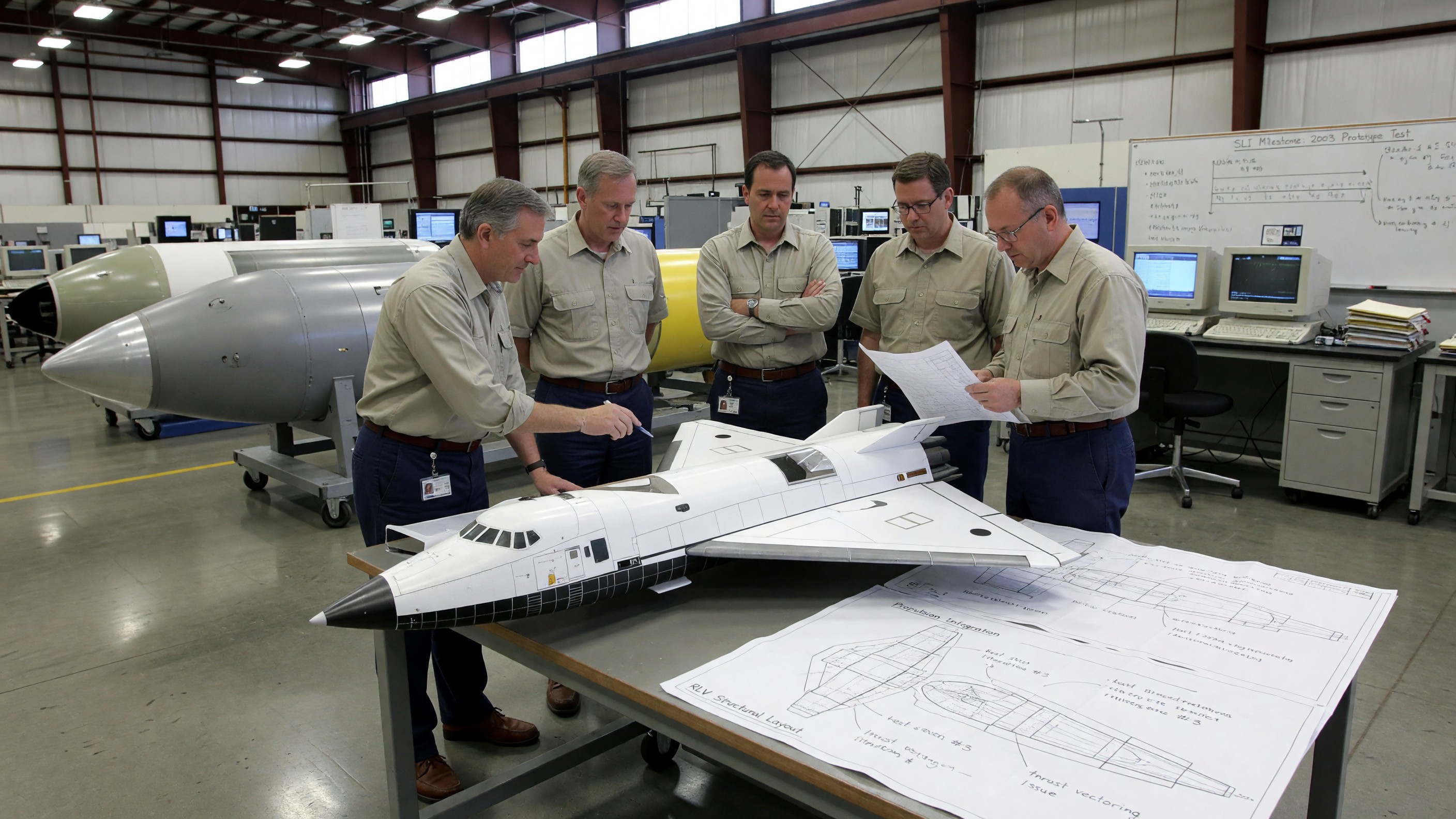
For a brief window at the turn of the millennium, NASA believed it could reinvent how humans and cargo reached orbit. The Space Launch Initiative, announced in 2001 and quietly wound down by 2004, was the agency’s most serious post-Apollo attempt to engineer a wholesale replacement for the Space Shuttle. Two decades on, the program is often remembered only as a footnote — eclipsed by Constellation, then Orion, then Artemis, and by the rise of commercial providers SpaceX and Blue Origin. Yet the engineering studies, contracting models, and hard lessons of SLI shaped nearly every U.S. launch program that followed.
What SLI Was Trying To Do
The Space Launch Initiative was conceived as the centerpiece of NASA’s Integrated Space Transportation Plan, a multi-decade framework that envisioned a steady evolution from the Shuttle to a fully reusable second-generation launch vehicle, often shorthanded as “2GRLV.” Where the Shuttle was a first-generation reusable system — partially expendable, costly to refurbish, and tightly coupled to its solid rocket boosters and external tank — the 2GRLV concept aimed at something more ambitious: a vehicle capable of carrying crew and cargo to low Earth orbit with airline-style turnaround times, dramatically lower per-pound costs, and an order-of-magnitude improvement in crew safety.
The official numerical goals were aggressive. NASA targeted a crew loss probability roughly ten times better than the Shuttle’s, a payload cost reduction from the Shuttle’s roughly $10,000 per pound to closer to $1,000 per pound, and turnaround times measured in weeks rather than months. Those were the headline metrics. Underneath them sat a sprawling technical program covering airframes, propulsion, avionics, thermal protection, and ground operations.
How The Program Was Organized
SLI was structured as a government-industry partnership rather than a traditional procurement. NASA Marshall Space Flight Center led the program office, with significant work distributed across Johnson, Kennedy, Langley, and Glenn. Industry partners were not asked to deliver a finished vehicle. Instead, they were funded to mature architecture concepts, retire key technical risks, and feed results back into a shared trade space.
Three major industry teams received architecture definition contracts: Boeing, Lockheed Martin, and a partnership led by Northrop Grumman with Orbital Sciences. Each team proposed distinct vehicle architectures — ranging from two-stage fully reusable systems to expendable-booster-plus-reusable-orbiter hybrids — and was paid to study, design, and test components rather than commit to a single configuration. NASA’s own Office of Inspector General has documented the breadth of this distributed effort in program audits from the period.
In parallel, the Next Generation Launch Technology program operated as the longer-horizon research wing, pushing on propulsion, materials, and guidance technologies that would not be ready in time for a 2010-era vehicle but were essential for the decade beyond.
What Was Actually Achieved
By the time SLI was restructured in late 2002 and effectively cancelled in 2004, the program had not produced a flight vehicle, a frozen design, or even a downselected architecture. By that narrow measure, it failed.
By a broader measure, it produced an enormous amount of engineering knowledge that simply did not exist before. Among the concrete deliverables:
- Multiple detailed architecture studies covering two-stage-to-orbit and stage-and-a-half configurations
- Significant work on the RS-84, a kerosene/LOX engine concept developed by Rocketdyne for first-stage applications
- Advances in reusable thermal protection systems, including improved tiles, blankets, and metallic concepts
- Integrated vehicle health management research that fed directly into modern avionics philosophies
- Composite cryogenic tank work that informed later programs at NASA and at commercial providers
- Substantial human factors and crew survivability data, particularly for abort scenarios
The program also produced something less tangible but arguably more valuable: a generation of aerospace engineers, at both NASA and the major contractors, who had spent three or four years thinking hard about reusability, refurbishment, and the economics of launch operations.
Why It Was Wound Down
The proximate cause of SLI’s end was the loss of Columbia on February 1, 2003. The accident forced NASA to redirect Shuttle resources toward Return to Flight and accelerated a strategic reassessment of human spaceflight that culminated in the Vision for Space Exploration, announced by President George W. Bush in January 2004. The Vision called for retiring the Shuttle by 2010, returning humans to the Moon, and developing a Crew Exploration Vehicle — which would become Orion. SLI’s broad reusable launch vehicle ambition no longer fit the new exploration architecture, which leaned toward expendable shuttle-derived boosters and a capsule-based crew vehicle.
The deeper cause was that SLI’s technical goals were probably unattainable on the budgets and timeline NASA was working with. A factor-of-ten improvement in safety, a factor-of-ten reduction in cost, and airline-style operations were each enormously difficult problems individually. Solving all three simultaneously, on a fixed government budget profile, within a single decade, was almost certainly impossible.
The Through-Line To Today
The most interesting legacy of SLI is what happened to its ideas after its cancellation. Several threads are worth tracing.
First, the Orbital Space Plane requirements work — initially carved out of SLI to address the narrower problem of ISS crew transport and rescue — became the direct intellectual ancestor of the Commercial Crew Program. The crew-of-four, ISS-docking, expendable-booster baseline that NASA defined in 2002 reads almost identically to the requirements that Boeing and SpaceX would later compete against.
Second, the propulsion research carried forward into NGLT and beyond. The RS-84 was never flown, but the design knowledge, test stand data, and workforce that worked on it dispersed into other projects — including, eventually, the kerosene engine work that informed Merlin development at SpaceX, where several SLI-era engineers ended up.
Third, the contracting model that SLI experimented with — government-funded technology maturation across multiple competing industry teams, with no commitment to a single architecture — was an early prototype for the COTS and Commercial Crew procurement approach that has since become standard. NASA’s Commercial Orbital Transportation Services program traces the lineage of that funded Space Act Agreement model.
What SLI Got Right And Wrong
In retrospect, SLI’s greatest error was probably timing. The fundamental technologies for fully reusable, rapidly turned-around launch — refurbishable engines, lightweight cryogenic structures, autonomous guidance, large-scale composite manufacturing — were not mature in 2001. Trying to integrate them into a single vehicle on a five-to-ten-year timeline was always going to be brittle.
What SLI got right was recognizing that the problem was real. The Shuttle was not going to be the long-term answer for U.S. access to space. Costs had to come down. Safety had to improve. Industry, not just NASA, had to bear meaningful risk. Those convictions, born in the SLI era, are now simply how the U.S. launch industry operates. The path from SLI to today was not direct, but the destination was correctly identified.
Frequently Asked Questions
Q: When did the Space Launch Initiative officially begin and end? A: SLI was announced in 2001 as part of NASA’s Integrated Space Transportation Plan and was effectively cancelled in 2004, following the Columbia accident and the announcement of the Vision for Space Exploration. The program was formally restructured in late 2002, with its more applied work narrowing into the Orbital Space Plane effort and its longer-horizon research consolidating under the Next Generation Launch Technology program.
Q: What was the relationship between SLI and the Orbital Space Plane? A: The Orbital Space Plane began as a subset of SLI, focused on the narrower near-term goal of ISS crew transport and rescue. As confidence in a full second-generation reusable launch vehicle eroded, OSP took on a larger share of the program’s resources before it too was absorbed into the Vision for Space Exploration’s Crew Exploration Vehicle work.
Q: Did any SLI hardware ever fly? A: No SLI vehicle reached flight. The program funded design studies, component-level testing, and ground demonstrations of propulsion and thermal protection technologies, but it was cancelled before any integrated vehicle was built.
Q: How much did the program cost? A: Public budget documents indicate NASA spent roughly $4 billion on SLI and its successor activities between 2001 and 2004, including the Orbital Space Plane and early NGLT work. Estimates vary depending on how associated technology research is accounted for.
Q: Did SLI influence SpaceX or other commercial providers? A: Indirectly, yes. Several engineers who worked on SLI propulsion and structures programs moved into the early commercial launch sector, and the propulsion research base that SLI helped sustain — particularly around hydrocarbon engines — informed the broader engineering environment in which Merlin, BE-4, and other commercial engines were later developed.