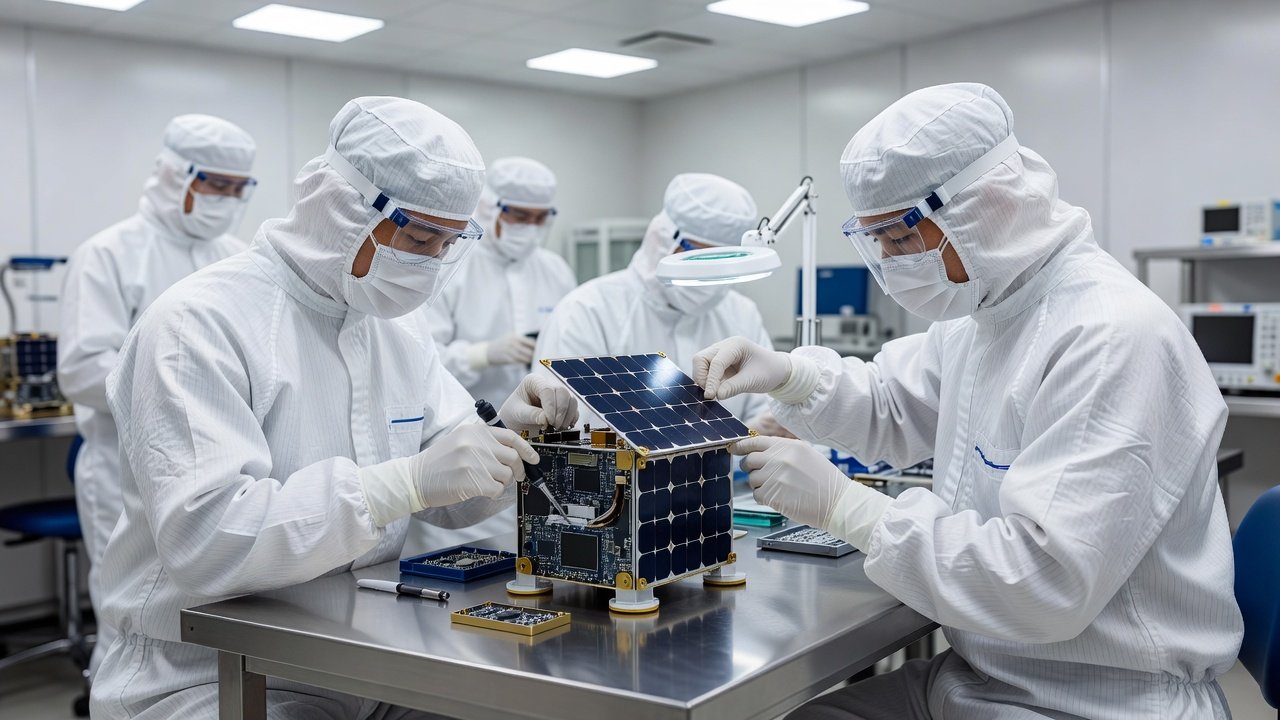
The 40th Annual Small Satellite Conference runs 23–26 August 2026 at the Salt Palace Convention Center in Salt Lake City, under the theme “The Clouds Above the Clouds — Celebrating 40 Years of Collaboration.”
One correction to the framing before anything else, because the date matters to the argument: the move to Salt Lake City did not happen in 2026. SmallSat relocated in 2025, when the 39th conference ran 10–13 August at the Salt Palace after 38 consecutive years at Utah State University in Logan. The 2026 edition is the second in the new venue, not the first.
That distinction is not pedantry. A conference’s first year in a larger venue tells you what the organisers hoped for. The second year tells you whether they were right.
What the move was actually about
The decision, announced in August 2024, was driven by capacity. USU’s facilities in Logan had been outgrown by attendance and, more acutely, by exhibitor demand — the constraint on a technical conference of this kind is almost always exhibition floor space rather than session seating. Cache Valley coverage at the time focused on the revenue leaving Logan, which was estimated in the millions annually and was a genuine loss to a small city that had hosted the event since 1987.
The industry-side reading is less sentimental. For most of its life, SmallSat was a working conference held on a university campus, with dormitory accommodation, a compressed geography that forced attendees into the same spaces, and a technical programme organised around peer-reviewed papers rather than product announcements. The character of the event was partly a function of its constraints.
Those constraints are gone. A downtown convention centre with hotel inventory, an international airport twenty minutes away, and a floor plan that can absorb a much larger exhibition is a different kind of venue, and it produces a different kind of event. Whether that is a gain depends entirely on what you came for.
The honest read on “growth”
There is a standard narrative available here — the smallsat sector grew up, the conference grew with it, and the move to a convention centre is the visible marker of an industry that is no longer a cottage enterprise. That story is broadly true and worth stating plainly: a field that in 1987 consisted of university groups and a handful of government programmes now supports constellations numbering in the thousands, commercial operators with real revenue, and a supply chain deep enough that a spacecraft integrator can buy nearly every subsystem off a catalogue.
The less comfortable observation is that conference growth and industry growth are not the same variable, and the correlation weakens precisely when a sector starts consolidating. Exhibition floor space tracks marketing budgets. Marketing budgets track funding rounds. A large exhibition floor in 2026 reflects capital raised in prior years as much as it reflects hardware flying now.
The measure that would actually settle the question is not attendance or booth count but the technical programme — how many papers, from how many distinct organisations, and how many of those organisations are flying hardware rather than proposing it. SmallSat’s peer-reviewed paper track has historically been the thing that distinguished it from a trade show, and it is the metric to watch in a venue where the exhibition has more room to expand than the session schedule does.
The 2026 theme is a constellation theme
“The Clouds Above the Clouds” is organised around the technologies behind successful satellite constellations, which is a sensible read of where the sector’s engineering problems now sit.
The interesting programmatic question for the smallsat community is that constellation operations have moved the hard problems away from the spacecraft. Building a capable 100-kilogram satellite is close to a solved problem in the sense that the components exist, the interfaces are standardised, and the schedule risk is manageable. Operating four hundred of them — with automated collision avoidance, ground-segment scheduling, on-orbit failure triage, and a replenishment cadence that assumes attrition — is not solved, and the expertise sits in a much smaller set of organisations.
That is a meaningful shift for a conference whose founding audience was people building individual spacecraft. A constellation-themed programme is an acknowledgement that the value in the sector has migrated from the bus to the system, and that the university lab which could once contribute a competitive spacecraft cannot contribute a competitive constellation.
What to watch in the sessions
Three areas are worth attention at this edition.
Ground segment and automation. The bottleneck for constellation operators is increasingly the ground, not the spacecraft, and it is where the least standardisation exists. Anyone claiming a general solution here is worth listening to sceptically and at length.
Collision avoidance and conjunction management at scale. The number of tracked objects and the number of conjunction warnings per operator per week have both risen faster than the tooling. This is the sector’s most under-discussed operational cost.
Propulsion for smallsats. The constellation replenishment model assumes controlled deorbit, which assumes propulsion on vehicles that historically did not carry it. The economics of that are still moving.
The 40th Small Satellite Conference runs 23–26 August 2026 at the Salt Palace Convention Center, Salt Lake City. Programme details are at smallsat.org.
Sources: SmallSat Conference · SpaceNews, “SmallSat heads to Salt Lake City as audience expands” · Deseret News, “Small Satellite Conference moving to Salt Lake”