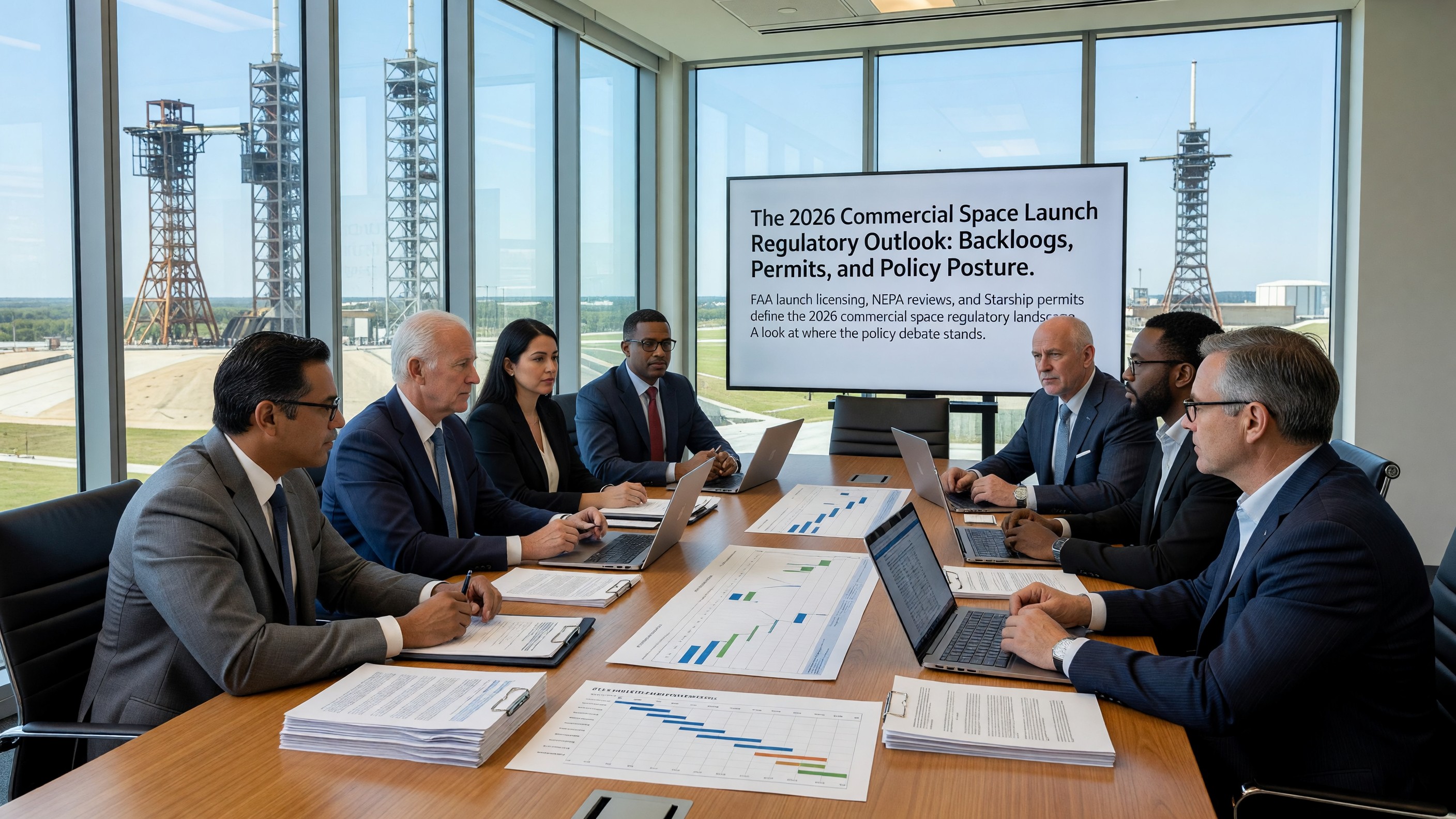
The commercial space launch industry begins 2026 in a regulatory environment that is more contested, more visible, and more consequential to the business than at any point in recent memory. Launch cadence has grown faster than the regulatory apparatus designed to oversee it. Environmental review processes designed for an era of perhaps a dozen launches per year are now being applied to a market on track for several hundred. And the political and policy posture toward commercial space — historically supportive across administrations — is being tested by the practical friction of permitting, environmental compliance, and the question of who should pay for the oversight infrastructure the industry requires.
This is a snapshot of where the regulatory picture stands as of early 2026, and where it is likely to move over the year ahead.
The FAA’s Role and the Office of Commercial Space Transportation
The Federal Aviation Administration’s Office of Commercial Space Transportation, commonly referred to as AST, is the primary federal regulator for U.S. commercial launch and reentry. AST licenses launch vehicle operations, reviews launch site operator licenses, conducts safety and risk analyses, and coordinates the environmental reviews required under the National Environmental Policy Act (NEPA) for new launch activities or significant changes to existing operations.
The office’s mandate has remained substantially stable over the past two decades, but the workload it manages has grown dramatically. In the early 2010s, the U.S. commercial launch industry conducted a handful of licensed missions per year. By the mid-2020s, that number had risen into the triple digits annually, driven primarily by SpaceX’s Falcon 9 cadence but increasingly supplemented by Vulcan Centaur, New Glenn, Rocket Lab’s Electron, and a growing list of small-launch entrants.
The staffing and resources available to AST have not grown at the same rate. Industry observers, including commercial launch operators, have argued for several years that the office is under-resourced relative to its workload. Congressional appropriations have modestly increased AST’s budget in recent cycles, but the gap between licensing throughput and industry demand remains a structural feature of the environment.
The Environmental Review Backlog
The most visible regulatory friction in 2026 is the backlog of NEPA environmental reviews. Any new launch site, significant change to an existing launch site, or new launch vehicle configuration at an existing site can trigger a NEPA review — either an Environmental Assessment for less significant changes or a full Environmental Impact Statement for major actions.
NEPA reviews are not optional and are not unique to commercial launch. They apply to a broad range of federal actions, from highway construction to military base modifications to energy infrastructure. The process is well-established in federal practice and includes public comment periods, agency coordination, and judicial review by interested parties.
For commercial launch, NEPA reviews have become a critical-path item. A launch operator that wants to add a new vehicle configuration, increase its annual flight rate beyond what its existing environmental review covered, or open a new launch site must complete the applicable review before the FAA can license the activity. Reviews that involve novel vehicles or significant cadence increases can take a year or more to complete, and litigation over completed reviews can extend the timeline further.
Starship, Boca Chica, and High-Profile Permit Friction
The most prominent example of regulatory friction in the current period involves SpaceX’s Starship program at Boca Chica, Texas. SpaceX has been operating its integrated flight test program under a series of FAA licenses, each of which has required environmental review and post-flight mishap investigation when anomalies occur.
The challenges at Boca Chica are not unique to Starship — they are the challenges of operating an unprecedented vehicle from a launch site adjacent to environmentally protected habitat. The site is near Boca Chica State Park and the Lower Rio Grande Valley National Wildlife Refuge, and launches affect both. The combination of a very large vehicle, a novel operations profile, and the proximity of protected habitat has made the environmental review process for Boca Chica more involved than for most other launch sites.
SpaceX has also pursued Starship operations from Kennedy Space Center in Florida, which requires its own environmental review. The Florida environmental work is in progress, and operational Starship flights from Florida are part of the company’s long-term plan. The Starship program is structured around eventual high-cadence operations from multiple sites, which will require resolved environmental authorizations at each.
The Boca Chica situation has become a recurring point of friction between SpaceX and federal regulators. The substantive policy question underneath the friction is real: how does the federal government balance the legitimate environmental interests that NEPA was designed to protect against the public interest in rapidly maturing a new launch capability? There is no clean answer, and the debate continues into 2026.
The Streamlining Debate
The broader policy debate around commercial launch regulation has crystallized around the question of streamlining. Industry advocates, supported by some members of Congress and several pieces of recent legislation, argue that the current NEPA process is poorly suited to high-cadence commercial launch and should be reformed.
Streamlining proposals generally take several forms. One approach is to expand the use of categorical exclusions — categories of activity that NEPA does not require individual review for. Another is to allow programmatic environmental reviews that cover a range of vehicle configurations or operational profiles, so that incremental changes do not each trigger a new review. A third is to set timelines or deadlines on NEPA reviews, limiting how long the process can take.
Critics of streamlining argue that the environmental review process exists for good reasons, that the impacts of launch activity on coastal habitats and local communities are real, and that reducing the rigor of review to accommodate industry cadence is the wrong trade-off. The debate is not new, and it has parallels in other federal permitting domains — energy infrastructure in particular — where similar streamlining versus rigor questions have been argued for decades.
The relevant Congressional committees with jurisdiction over commercial space — primarily the House Science Committee and the Senate Commerce Committee — have indicated interest in commercial launch competitiveness legislation, but no comprehensive package had advanced to enactment as of early 2026.
The National Space Policy Context
The broader National Space Policy framework provides the strategic context within which the licensing and environmental questions sit. The National Space Policy is the formal document that articulates the U.S. government’s overall posture toward space activities. It is updated periodically and serves as the orienting framework for agency activities across NASA, the FAA, the Department of Defense, and other federal agencies with space equities.
The current framework continues to identify commercial space as a strategic priority, both for economic competitiveness and national security purposes. The policy direction has been broadly consistent across administrations in supporting commercial space generally, though specific emphases — on regulatory streamlining, on workforce development, on competition with China — shift with changes in administration.
The practical implication for industry is that the strategic-level policy direction is supportive, but the implementation friction at the agency level — particularly at the FAA — is where the day-to-day regulatory experience lives. A favorable National Space Policy does not, by itself, accelerate an environmental review or expand AST’s staffing.
What to Watch in 2026
Three things are worth tracking for the rest of the year.
The first is whether comprehensive commercial launch legislation advances in Congress. Several proposals have been circulating for the past two sessions, with various combinations of streamlining provisions, AST resourcing increases, and updates to the legal framework for commercial reentry and on-orbit operations. Whether any advance to enactment is the most consequential variable for the medium-term regulatory environment.
The second is the resolution of the Starship permitting picture — both the ongoing Boca Chica situation and the Florida environmental work for Kennedy Space Center operations. The outcomes will set precedents for how future high-cadence operations of novel vehicles are reviewed.
The third is the FAA’s own internal posture toward streamlining within existing legal authority. The agency has discretion in how it conducts NEPA reviews, how it structures licenses, and how it allocates staff. Internal process improvements at AST, without any new legislation, could meaningfully change the experience of regulated entities.
The commercial space launch industry in 2026 is operating at a scale that the regulatory framework was not designed for. Whether the framework adapts, and how, will shape the industry’s growth trajectory for the rest of the decade.
Frequently Asked Questions
Q: What is the FAA’s Office of Commercial Space Transportation? A: AST is the FAA office responsible for licensing commercial launch and reentry operations in the United States. It conducts safety reviews, coordinates environmental reviews under NEPA, and licenses launch sites and operators.
Q: Why are environmental reviews such a significant issue for commercial launch? A: NEPA requires federal agencies to evaluate the environmental impacts of major federal actions before authorizing them. As launch cadence has risen dramatically, the volume and complexity of required reviews has grown, creating timeline friction for operators seeking to expand their activities.
Q: What is the situation with Starship and Boca Chica? A: SpaceX’s Starship operations at Boca Chica are subject to ongoing FAA environmental and licensing oversight, complicated by the site’s proximity to protected habitat in South Texas. The program also requires environmental authorization for planned operations at Kennedy Space Center in Florida.
Q: What is regulatory streamlining and why is it controversial? A: Streamlining refers to proposals to reduce the time and procedural burden of NEPA environmental reviews for commercial launch. Supporters argue current processes are poorly suited to high-cadence operations. Critics argue the reviews exist to protect real environmental and community interests.
Q: What is the National Space Policy? A: The National Space Policy is the formal document articulating U.S. government posture toward space activities. It provides strategic-level direction across federal agencies and has been broadly supportive of commercial space across recent administrations.
Q: What should the industry expect from Congress in 2026? A: Several commercial launch competitiveness proposals are in circulation, with combinations of streamlining provisions, AST resourcing, and updates to the commercial space legal framework. Whether any comprehensive package advances to enactment remains uncertain as of early 2026.