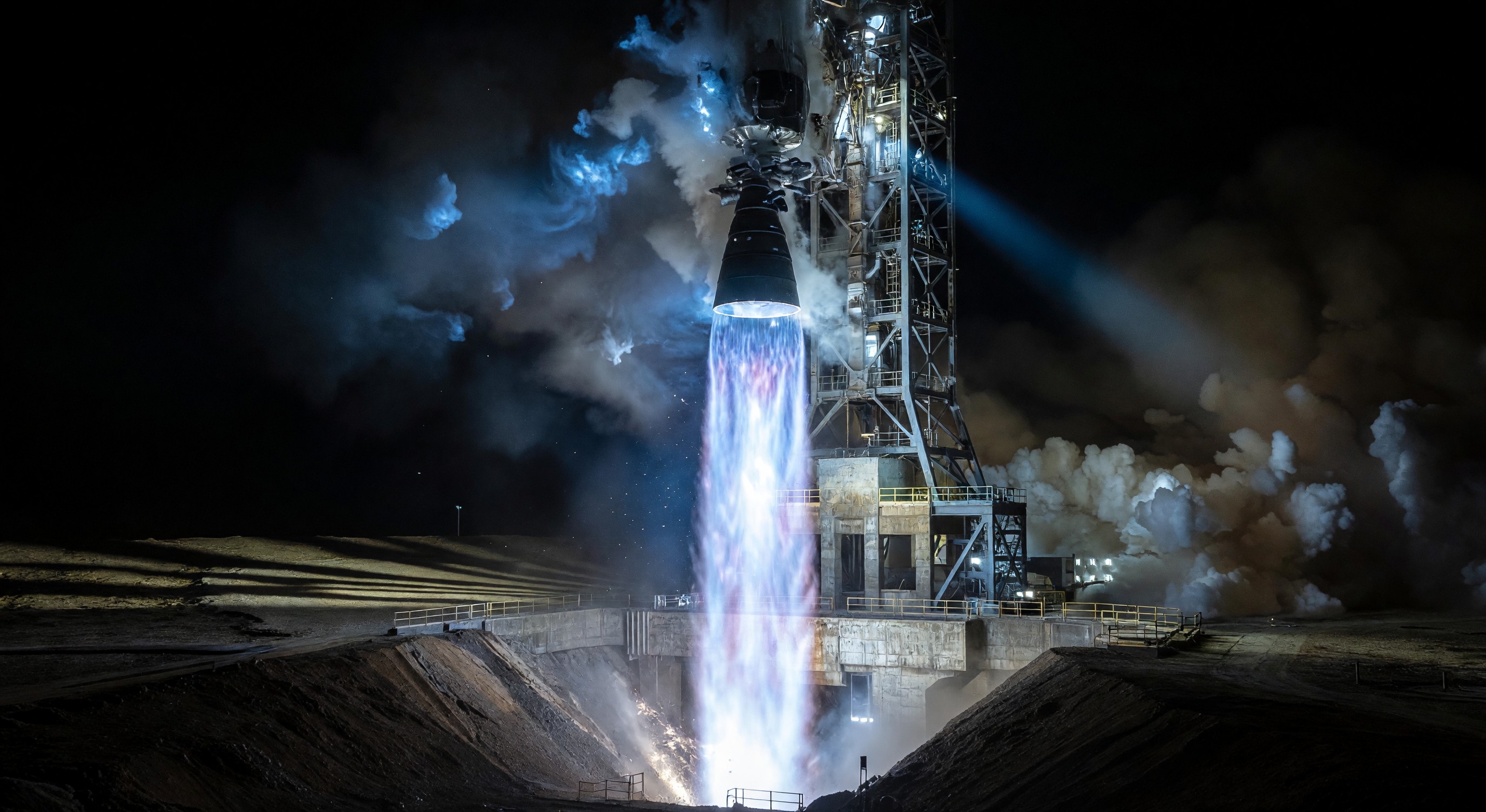
When two independent development programs — one at SpaceX, one at Blue Origin — both converged on liquid methane as the propellant choice for their next-generation rocket engines, it was not a coincidence. The simultaneous arrival of methane as the preferred choice for high-performance reusable engines reflects a genuine technical consensus, one that has significant implications for the propulsion architecture of the commercial launch industry for the foreseeable future.
SpaceX’s Raptor engine powers both stages of Starship. Blue Origin’s BE-4 powers the first stage of New Glenn and serves as the first-stage engine for ULA’s Vulcan Centaur. Two different engines, two different design philosophies, two different performance targets — but the same propellant combination: liquid oxygen and liquid methane. Understanding why both programs made this choice requires looking at what methane actually offers compared to the alternatives.
The Propellant Landscape Before Methane
The dominant propellants in the history of liquid-fueled rockets fall into a few major categories.
Liquid oxygen and kerosene (RP-1) is the workhorse combination: used in Atlas, Delta, Saturn V’s first stage, Falcon 9, and a long list of other vehicles. Kerosene has high energy density, is easy to handle at ambient temperature, and has a long track record. Its principal limitation for reusable vehicles is coking — carbon deposits from combustion that accumulate in engine plumbing, turbopumps, and injectors, requiring intensive cleaning between flights.
Liquid oxygen and liquid hydrogen achieves the highest specific impulse of any practical propellant combination — the gold standard for upper stages and high-efficiency applications. The Space Shuttle’s main engines, the J-2 engine used in the Saturn V’s upper stage, and ULA’s Centaur upper stage all use this combination. The limitation is handling: liquid hydrogen must be stored at -253°C, has extremely low density (requiring very large tanks), requires specialized insulation, and permeates and embrittles metals if not handled carefully. Cryogenic ground operations for liquid hydrogen are expensive, complex, and time-consuming.
Hypergolics — propellants that ignite spontaneously on contact — have been used extensively in spacecraft maneuvering and in some launch vehicles. They require no ignition system and offer long storage life, making them useful for spacecraft that must restart reliably after months in space. They are, however, highly toxic, creating significant handling costs and environmental concerns.
Why Methane Occupies the Middle Ground
Liquid methane sits between kerosene and liquid hydrogen in performance and handling characteristics — and it turns out that middle ground is exactly where reusable vehicle design needs to be.
Cleanliness. Methane is a simple hydrocarbon — a single carbon atom bonded to four hydrogen atoms. When it burns completely with liquid oxygen, the combustion products are carbon dioxide and water. There is no coking: no carbon deposits on injectors, no tarring in turbopumps, no buildup that accumulates with each reflight. This is the primary reason both SpaceX and Blue Origin chose methane. A kerosene engine that has made 20 flights has decades of soot accumulation in its internal passages. A methane engine has not.
The practical consequence is dramatically reduced refurbishment between flights. If the design target is a reusable engine that requires only inspection — not cleaning, not replacement of carbonized components — before the next flight, methane’s clean combustion is a structural enabler.
Performance. Methane delivers specific impulse between kerosene and hydrogen. The Raptor engine achieves specific impulse figures in the 350–380 second range (sea level to vacuum), compared to Falcon 9’s Merlin 1D at roughly 282 seconds (sea level) to 348 seconds (vacuum), and RL10 hydrogen-fueled upper stage engines at 450+ seconds. Methane doesn’t match hydrogen’s peak efficiency, but it approaches it more closely than kerosene does.
Cryogenic handling at manageable temperature. Methane liquefies at approximately -161°C at atmospheric pressure — cold, but not as extreme as hydrogen’s -253°C. Methane can share cryogenic infrastructure concepts with liquid oxygen (-183°C), which simplifies ground systems design. The handling challenges are real but substantially less demanding than liquid hydrogen operations.
Deep throttling compatibility. Methane’s combustion stability characteristics support deep throttling — reducing engine thrust to a small fraction of maximum — which is essential for propulsive landing. A booster decelerating for a vertical landing needs to throttle down to a fraction of its nominal thrust to land gently. Both Raptor and BE-4 are designed with throttling ranges that support propulsive landing operations.
Potential for in-situ resource utilization. Methane can be synthesized from carbon dioxide and water through the Sabatier reaction — a chemistry process that produces methane and water from CO2 and hydrogen. Mars has abundant CO2 in its atmosphere and water ice in its subsurface. SpaceX has been explicit that this is a design consideration for Raptor: a vehicle designed to be refueled on Mars needs a propellant that can be made on Mars. This consideration is less relevant to current operational launch vehicles, but it reflects the long-range thinking behind the choice.
Raptor: Full-Flow Staged Combustion
SpaceX’s Raptor engine uses full-flow staged combustion, a thermodynamic cycle that achieves the highest possible efficiency from a bipropellant engine. In staged combustion, the fuel (or oxidizer) is pre-burned in a smaller combustor called a preburner, and the resulting hot gas drives the turbopumps before entering the main combustion chamber. Full-flow staged combustion uses two preburners — one fuel-rich for the fuel turbopump and one oxidizer-rich for the oxidizer turbopump — so both propellants flow through preburners before entering the main chamber.
The thermodynamic advantage is that the engine extracts work from all of the propellant through the turbopumps before combustion, maximizing cycle efficiency. Full-flow staged combustion is technically demanding: the oxidizer-rich preburner operates at high temperature and pressure with liquid oxygen flowing through it in conditions that are corrosive to most materials. The Soviet Union’s RD-180 and NK engines used oxygen-rich staged combustion, demonstrating the engineering feasibility. Raptor is the first full-flow staged combustion engine to reach operational service.
Raptor’s chamber pressure — the pressure at which propellants combust in the main chamber — is significantly higher than prior production engines, reportedly above 300 bar in later versions. Higher chamber pressure improves efficiency but requires stronger (and heavier) engine structures and more demanding manufacturing. SpaceX has made high chamber pressure a core design objective, and Raptor’s reported chamber pressure values represent a significant advance in production engine performance.
BE-4: Oxygen-Rich Staged Combustion
Blue Origin’s BE-4 uses oxygen-rich staged combustion — a mature cycle type with the Russian-heritage RD-180 as the most prominent Western example. In oxygen-rich staged combustion, an oxidizer-rich preburner drives the turbopumps, and the hot oxygen-rich gas enters the main combustion chamber along with the fuel. The cycle achieves high efficiency without the full complexity of full-flow staged combustion.
BE-4 was designed as a commercial engine — suitable for Blue Origin’s own vehicles (New Glenn) and available to external customers (ULA’s Vulcan Centaur). This dual-customer design requirement influenced the engine’s development path. It needed to meet the integration requirements of two different vehicle programs with different structural interfaces, different controller architectures, and different operational requirements. BE-4’s development took longer than originally planned, and engine availability was a significant factor in delays to both New Glenn and Vulcan Centaur’s timelines.
BE-4’s design thrust level — approximately 2.4 meganewtons per engine — positions it for heavy-lift first stages. Two BE-4 engines power Vulcan’s first stage; New Glenn uses seven. The engine’s development represents a substantial investment in domestic U.S. methane propulsion capability that was not available before this program.
Performance Comparison and Market Implications
Raptor and BE-4 are not direct competitors — they serve different vehicle classes and are not designed to the same specifications. Raptor targets the highest possible specific impulse and chamber pressure for a vehicle (Starship) whose economics depend on maximum performance per flight. BE-4 targets reliability and commercial versatility for vehicles (New Glenn, Vulcan) whose economics depend on cost-effective production and operation across diverse mission profiles.
What they share — methane propellant, reusability design intent, and high chamber pressure relative to prior engines — signals the direction of propulsion technology for next-generation launch vehicles. Rocket Lab’s Archimedes engine for Neutron also uses methane — the vehicle’s development and market positioning are examined in the Neutron development update. Rocket engines currently in paper design phases at various companies are predominantly methane designs.
The shift is significant for launch infrastructure. Every established launch pad built for kerosene or hydrogen has ground systems incompatible with methane. New methane launch complexes require different propellant storage, different transfer equipment, and different conditioning systems. The infrastructure investment at Boca Chica, Kennedy Space Center’s LC-39A, Cape Canaveral’s SLC-36, and Rocket Lab’s Wallops complex all reflect a turn toward methane that will shape launch geography for decades.
Frequently Asked Questions
Why did SpaceX and Blue Origin both choose methane for their new engines?
Both programs independently concluded that methane’s combination of clean combustion (eliminating coking that plagues kerosene engines) and better performance than kerosene makes it the optimal choice for reusable vehicles designed for high flight rates. Methane is also storable at manageable cryogenic temperatures compared to liquid hydrogen.
What is the difference between Raptor and BE-4 thermodynamic cycles?
Raptor uses full-flow staged combustion, where both propellants pass through preburners before the main combustion chamber — the highest-efficiency combustion cycle for bipropellant engines. BE-4 uses oxygen-rich staged combustion, a slightly simpler cycle where only the oxidizer side uses a preburner. Both cycles are more efficient than the gas generator cycles used in most prior Western engines.
Can a methane engine be used on multiple flights without major refurbishment?
That is the design intent. Methane’s clean combustion eliminates the coking that requires intensive cleaning of kerosene engines between flights. In practice, this is being demonstrated operationally as Raptor accumulates flight cycles on Starship and BE-4 accumulates flights on New Glenn and Vulcan. The actual refurbishment requirements at high flight counts remain to be fully characterized.
What is in-situ resource utilization and why does it matter for methane?
In-situ resource utilization (ISRU) refers to using resources available at a destination — on the Moon, Mars, or elsewhere — to produce propellant rather than carrying everything from Earth. Methane can be produced from Mars’s carbon dioxide atmosphere through the Sabatier reaction, making it compatible with a Mars propellant production concept. This is a long-term consideration that influenced Raptor’s design but does not affect near-term Earth-launch operations.
How does methane handle differently from kerosene for ground operations?
Methane requires cryogenic storage, which kerosene does not — it must be stored as a liquid at approximately -161°C. This requires insulated storage tanks, specialized transfer lines, and conditioning procedures before loading. The handling complexity is greater than kerosene but significantly less than liquid hydrogen, which requires even colder temperatures and has more challenging permeation and embrittlement issues.
Why did BE-4 development take longer than planned?
Blue Origin attributed delays to the technical challenges of developing a new high-performance engine — particularly in the oxidizer-rich preburner operating environment, which exposes components to hot, oxygen-rich conditions demanding specialized materials and manufacturing. The engine also had to meet two different vehicle integration programs simultaneously, adding coordination complexity.
Further Reading from Authoritative Sources
- NASA Technical Reports Server — Propulsion Research and Methane Engine Studies — NASA’s technical library contains extensive research on methane propulsion, staged combustion cycles, and reusable engine design relevant to understanding both Raptor and BE-4’s technical foundations.
- FAA Office of Commercial Space Transportation — Launch Vehicle Technical Standards — the FAA’s commercial space office oversees the safety certification of launch vehicles and their propulsion systems, providing regulatory context for how new engine technologies are qualified for commercial service.