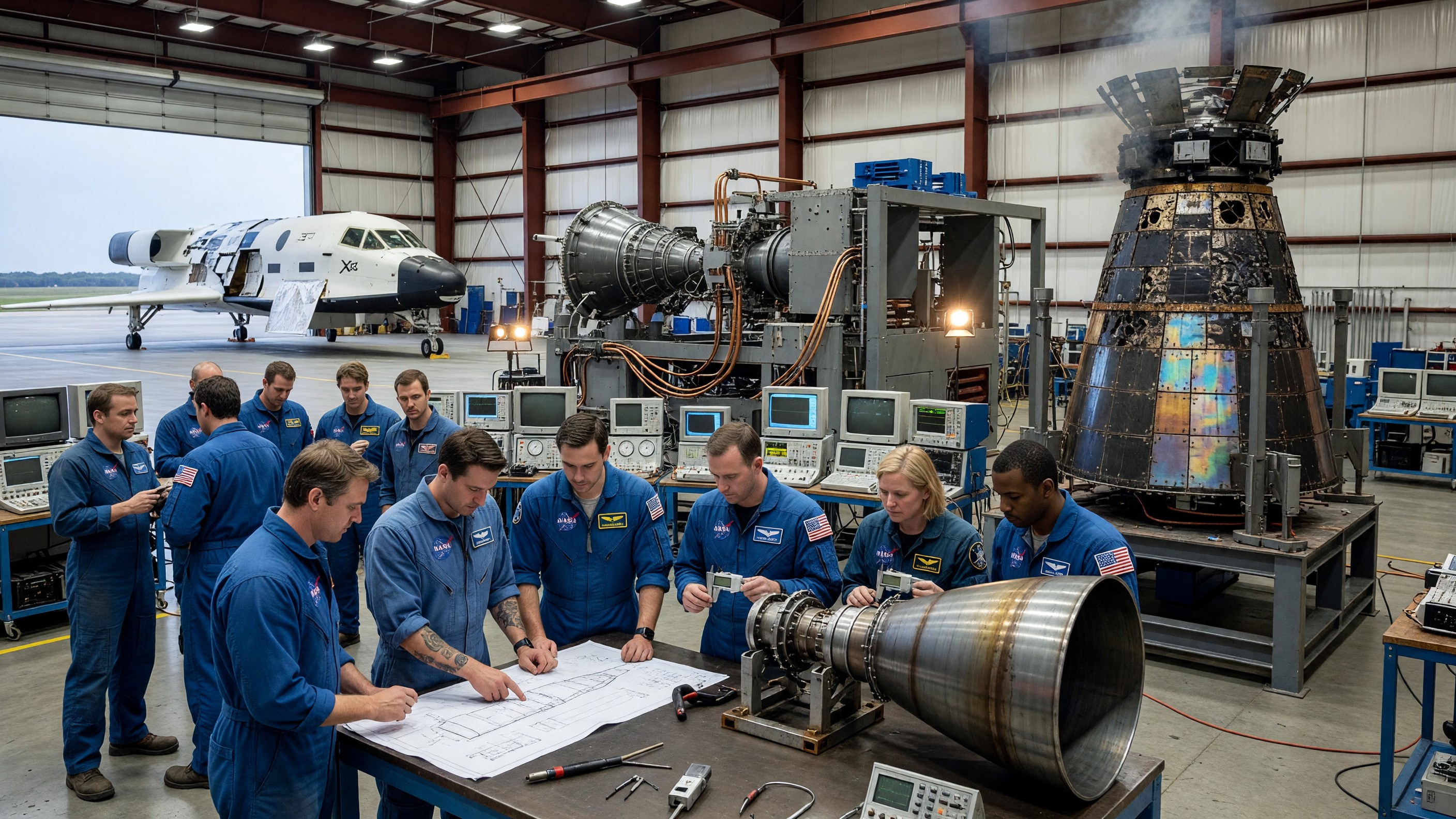
Among the alphabet soup of early-2000s NASA programs — SLI, OSP, ISTP, CEV — the Next Generation Launch Technology program is the least remembered and arguably the most quietly influential. While SLI was trying to define a second-generation reusable launch vehicle for the late 2010s, NGLT was looking further out, into the technologies that would be needed for genuinely operational, airline-like reusable launch in the decade beyond. NGLT did not produce a vehicle. It produced a research base that, two decades later, still echoes in the engines, materials, and avionics of nearly every modern launcher.
Where NGLT Sat In The Architecture
NASA’s Integrated Space Transportation Plan, the strategic framework that organized the agency’s launch-related work in the early 2000s, drew a deliberate distinction between near-term and long-term efforts. The near-term work — the actual vehicle development — sat inside the Space Launch Initiative and, later, the Orbital Space Plane program. The long-term technology research lived in NGLT.
The split made sense. The technologies needed for a 2010-era 2GRLV were within reach of focused development. The technologies needed for a fully reusable, two-stage-to-orbit vehicle with airline turnaround in the 2020s were not. They required basic research, materials science work, propulsion concept exploration, and a generation of small-scale demonstrators. NGLT was structured to fund that longer horizon without being subordinated to a specific vehicle program’s schedule pressures.
The program ran formally from roughly 2002 through 2005, when much of its funding was absorbed into Constellation. Its peak budget was modest by NASA standards — a few hundred million dollars per year — but it was spread across a tightly focused set of technology areas.
The Core Research Areas
NGLT’s research portfolio was organized into a handful of major thrusts. Four are particularly important to understanding the program’s legacy.
Advanced Propulsion
Propulsion absorbed the largest share of NGLT funding, and within propulsion the focus was on technologies enabling reusable, restartable, refurbishable engines. Specific work areas included:
- Long-life turbomachinery. Conventional rocket turbopumps are designed for one or a handful of duty cycles. Reusable engines need turbopumps that can survive dozens of starts, dozens of throttling profiles, and accumulated thermal stress without expensive refurbishment. NGLT funded materials, bearing, and seal research aimed at extending pump life by an order of magnitude.
- Reusable LOX/hydrogen engines. Concepts derived from the SSME lineage, including incremental improvements to the existing engine, but also clean-sheet concepts aimed at simpler architectures with fewer parts.
- Hydrocarbon engine work. Significant funding went to hydrocarbon — kerosene — engine research, including the RS-84 concept at Rocketdyne, which envisioned a 1-million-pound-thrust class LOX/RP-1 engine for first-stage applications.
- Combined-cycle concepts. Long-horizon research into turbine-based combined-cycle and rocket-based combined-cycle engines for hypersonic and access-to-space applications, work that connected to parallel efforts in the NASA aeronautics research community.
Thermal Protection Systems
The Shuttle’s tile-based TPS had taught NASA an enormous amount about what not to do for a second-generation reusable vehicle. NGLT funded research into:
- Durable, low-maintenance TPS concepts including blanket materials and metallic shingle approaches
- Hot structures that integrated the load-bearing function with thermal protection, reducing parts count
- Improved inspection and refurbishment techniques to support faster turnaround
- Material characterization across a wider temperature and load envelope than existing TPS qualification covered
Airframes And Structures
Lightweight, durable, reusable airframes meant composite primary structures and large cryogenic composite tanks. NGLT funded fundamental work on:
- Composite cryogenic tank development, building on prior X-33 tank experience and aiming for tanks that would not suffer the delamination problems that had plagued that program
- Integrated vehicle structures that combined tank, airframe, and TPS functions
- Manufacturing process research aimed at reducing the unit cost of large composite structures
Guidance, Navigation, And Control
Reusable launch operations require autonomy. NGLT funded research into:
- Adaptive guidance and control algorithms that could compensate for vehicle health degradation between flights
- Integrated vehicle health management — sensors, data fusion, and decision logic that could detect emerging failures and respond appropriately
- Autonomous flight termination and abort logic compatible with operational reuse
The Contractor Base
NGLT’s contracting model mirrored SLI’s. Work was distributed across the major aerospace primes and propulsion companies, with significant participation from Pratt & Whitney Rocketdyne (then in transition through several corporate ownerships), Aerojet, Boeing, Northrop Grumman, and Lockheed Martin. NASA research centers — Marshall, Glenn, Langley, Ames — held substantial in-house portions of the work, particularly in propulsion test and materials research.
This contractor base mattered. NGLT was, in part, an instrument for keeping a critical mass of propulsion engineers employed and current at a time when the commercial launch market was thin and the Shuttle workforce was aging. The program funded test stand operations, materials laboratories, and design teams that would otherwise have dispersed. When new programs emerged later in the decade — Constellation, then the commercial era — that workforce was still available.
What NGLT Actually Produced
NGLT did not produce a flight engine or a flight vehicle. It produced research deliverables:
- Substantial design and component-test data on the RS-84 hydrocarbon engine, which was never built but which generated detailed turbopump, injector, and combustion chamber data
- Component test data on advanced LOX/hydrogen engine concepts, including work on simplified gas-generator and full-flow staged combustion architectures
- Materials qualification data for new TPS concepts
- Composite cryogenic tank test data that addressed some of the failure modes seen in earlier programs
- A body of GN&C and IVHM research that fed directly into subsequent vehicle programs
When NGLT was wound down and its funding redirected toward Constellation, much of this work was repurposed. The J-2X engine development for the Ares I upper stage drew on NGLT-era hydrogen engine research. RL-10 improvement studies leveraged NGLT turbomachinery work. Composite tank knowledge fed into subsequent NASA technology demonstrations.
The Commercial Connection
The more interesting question is how NGLT’s research base influenced the commercial launch sector. The connection is not always direct — SpaceX did not build a Merlin engine from NGLT blueprints — but it is meaningful.
First, NGLT helped sustain a U.S. hydrocarbon engine community at a time when the country had no operational large hydrocarbon engine. The RS-84 concept, the underlying turbopump research, and the workforce that worked on these problems formed part of the engineering environment in which Merlin was conceived and developed. NASA’s historical documentation of its commercial programs traces how these workforce and technology threads carried into the commercial era.
Second, the IVHM and autonomy research that NGLT funded contributed to a general elevation of expectations around launch vehicle autonomy. The autonomous flight safety systems that are now standard on Falcon 9 and other commercial launchers operate in a regulatory and technical environment that NGLT-era work helped shape.
Third, the methane engine concepts that have come to dominate the modern engine landscape — Raptor, BE-4 — were not directly studied under NGLT, which focused on kerosene and hydrogen. But the materials, turbopump, and combustion stability research from that era was directly applicable when methane engine development began in earnest later in the decade.
What NGLT Got Right
The most important judgment NGLT made was that the path to operationally reusable launch ran through propulsion. Airframes, avionics, and operations all mattered, but engines — long-life, restartable, refurbishable engines — were the hardest problem and the longest-lead item. By investing heavily in propulsion research in the early 2000s, NGLT created a knowledge base that paid dividends well after the program itself ended.
It is fair to say that NGLT was ahead of its time. The full vision it was reaching toward — fully reusable, two-stage-to-orbit, airline-like launch — was not realized in the 2010s. It is, arguably, being realized now, twenty years later, by Falcon 9, Starship, and New Glenn. NGLT did not build those vehicles. But it helped build the engineering environment in which they became possible.
Frequently Asked Questions
Q: What was the Next Generation Launch Technology program? A: NGLT was NASA’s early-2000s research program for advanced launch technologies, focused on propulsion, thermal protection, airframes, and guidance technologies needed for fully reusable launch vehicles in the 2010s and beyond. It operated alongside the Space Launch Initiative as the longer-horizon research wing of the Integrated Space Transportation Plan.
Q: When did NGLT operate? A: The program ran formally from roughly 2002 through 2005, when much of its funding was redirected into the Constellation program. Some NGLT research lines continued for several years afterward under different program names.
Q: What was the RS-84 engine? A: The RS-84 was a proposed LOX/RP-1 first-stage engine concept developed by Rocketdyne under NGLT funding. It was envisioned as a roughly one-million-pound-thrust class engine for use on next-generation reusable boosters. The engine was never built as a complete unit, but substantial component-level design and test data was produced.
Q: Did NGLT contribute to SpaceX’s Merlin engine? A: Not directly. NGLT did not transfer designs to SpaceX. The influence is indirect: NGLT helped sustain a U.S. hydrocarbon engine engineering community, generated research data on turbopumps and combustion devices, and funded a generation of propulsion engineers who later contributed to the commercial launch sector.
Q: Why is NGLT less well-known than SLI or Constellation? A: NGLT did not produce a flight vehicle or a single visible end product. Its outputs were research deliverables — test data, component qualifications, design studies — that fed into subsequent programs rather than appearing as standalone achievements. Programs that produce hardware tend to be remembered; programs that produce knowledge tend to be cited and then forgotten.