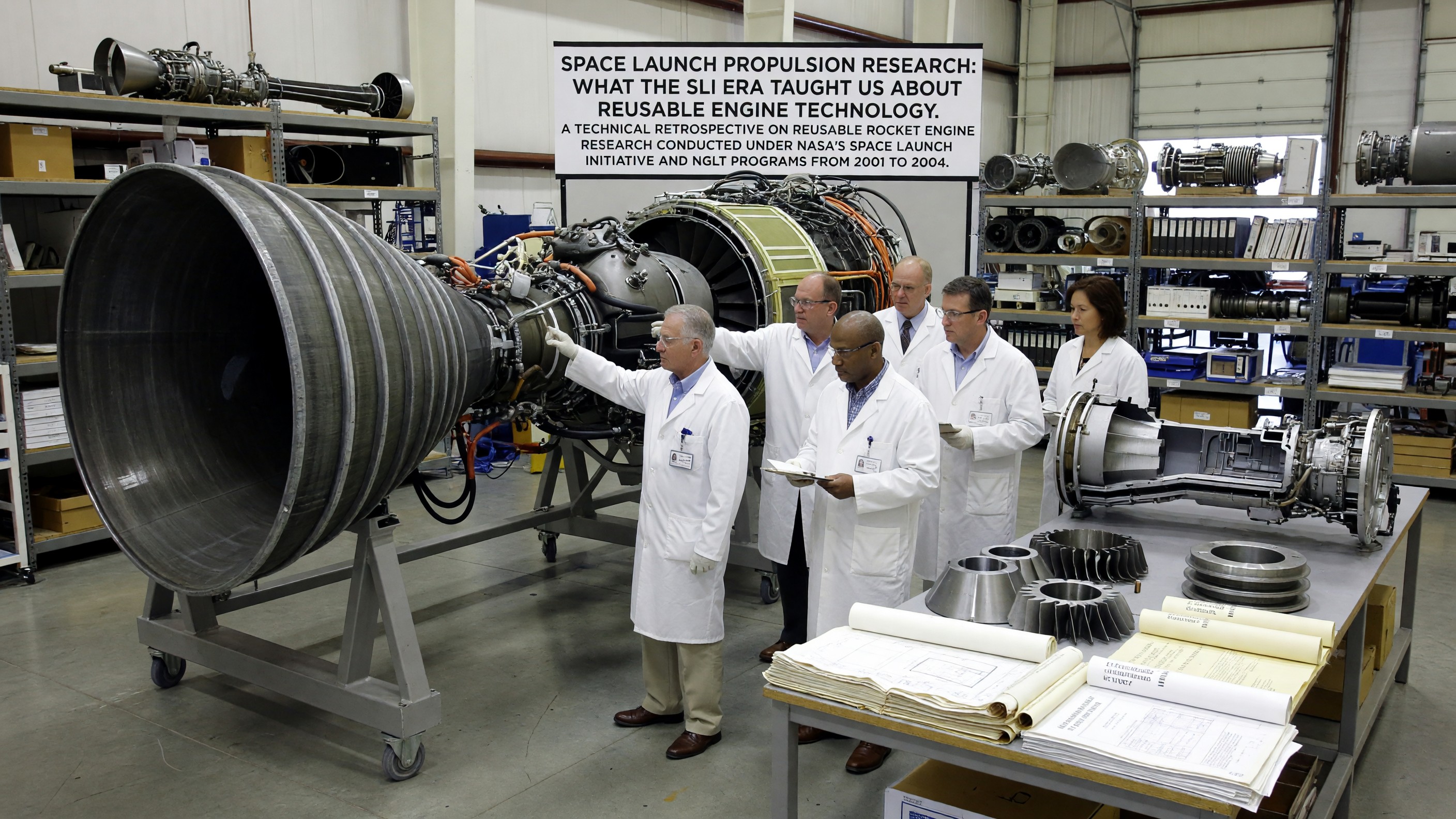
The Space Launch Initiative and its sibling Next Generation Launch Technology program never produced a flight engine. By the metric of hardware delivered, the era’s propulsion research could be dismissed as a dead end. By the metric of knowledge produced — about reusable engine architectures, about turbopump life, about combustion stability across many restarts, about the unforgiving economics of refurbishment — the era was foundational. Most of what the modern launch industry assumes about reusable rocket engines was learned, or first carefully formalized, in the 2001–2004 window.
The Core Problem: Reusable Is Not Just Multi-Start
The central insight of SLI-era propulsion research, and one that took several years to fully crystallize, is that a “reusable” rocket engine is a fundamentally different machine from a multi-start expendable engine. The Space Shuttle Main Engine — the high-water mark of late-20th-century reusable rocket engine engineering — was reusable in name. In practice, every SSME flight was followed by an extensive teardown, inspection, component replacement, and recertification cycle that consumed weeks of work and significant labor cost.
For a truly operational reusable launcher, that model is unaffordable. The engine has to survive a flight, undergo a minimal inspection, and fly again — ideally within days, not weeks. That requirement reshapes the engine across every subsystem. Specifically:
- Turbopumps must survive many start transients without bearing or seal wear that requires intervention
- Combustion devices must tolerate dozens of thermal cycles without coking, erosion, or fatigue cracking
- Injectors must restart reliably across a wide operating envelope without combustion instabilities
- Nozzles must tolerate accumulated thermal stress
- Sensors and avionics must remain calibrated across many flights without recurrent ground intervention
Each of these is a hard problem individually. Solving all of them at once, on a cost-competitive engine, is what reusable propulsion really means. SLI-era research, more than anything else, scoped that problem precisely.
The Propellant Choice Debate
A central technical debate of the SLI era — one that played out in trade studies, contractor proposals, and NASA internal memos — was the choice of propellant for a reusable first stage. The choice was not abstract. It drove engine architecture, vehicle mass, ground operations, and refurbishment cost.
LOX/hydrogen. Hydrogen offered the highest specific impulse and the cleanest combustion products, with minimal coking risk. It also imposed enormous penalties on vehicle dry mass through low density (large tanks), boil-off losses (insulation and ground operations complexity), and embrittlement (materials selection). The Shuttle’s SSME experience was the existing knowledge base, but the operational lessons from SSME suggested that LOX/hydrogen reusability was viable but expensive.
LOX/RP-1. Kerosene fuel offered density advantages, simpler ground handling, lower vehicle dry mass at the cost of lower specific impulse, and the engineering challenge of coking and soot deposition during sustained operation. The U.S. had not built a major new LOX/RP-1 engine since the F-1 and the H-1. The Russian RD-180, which Lockheed Martin had begun importing for Atlas III and Atlas V, demonstrated that high-performance staged-combustion kerosene engines were technically achievable, but the U.S. industrial base had atrophied.
The SLI/NGLT consensus tilted toward kerosene for first stages, which informed the RS-84 development effort.
The RS-84
Among the most consequential, and least remembered, SLI-era propulsion programs was the RS-84, a Rocketdyne concept for a roughly million-pound-thrust class LOX/RP-1 engine intended for reusable first-stage applications. The engine was conceived as oxidizer-rich staged combustion, the architecture that the Russians had mastered with the RD-170/180 family but which the U.S. industry had not built at scale.
Component-level work proceeded on injectors, preburners, and turbomachinery. Hot-fire testing of component-scale articles was conducted at NASA Marshall and at Rocketdyne facilities. The engine was never built as an integrated unit before NGLT funding was redirected toward Constellation, but the design and test data produced were substantial. NASA’s Marshall Space Flight Center has documented portions of this effort, and trade press coverage from the period captures the technical milestones reached.
The RS-84 mattered for several reasons. It re-established a U.S. design knowledge base for large hydrocarbon staged combustion engines after decades of dormancy. It demonstrated that oxidizer-rich staged combustion was achievable with U.S.-domestic engineering — a question that had been genuinely uncertain at the start of the program. And it sustained a population of propulsion engineers who would later contribute, at various companies, to other large hydrocarbon engine efforts.
The J-2 Revival Conversations
A parallel propulsion debate concerned upper-stage engines. The J-2, the LOX/hydrogen engine that had powered the Saturn V upper stages, was studied for potential revival under various names — J-2S, and later J-2X under Constellation. The technical arguments were straightforward: J-2 was a known, demonstrated design, with reasonable performance and a long operational record.
SLI-era studies surfaced the limits of this approach. J-2 was designed in the 1960s, on materials and manufacturing assumptions that no longer reflected best practice. A literal revival was not feasible; what was feasible was a J-2-derivative that preserved the architecture while modernizing the materials, manufacturing, and avionics. That logic ultimately produced J-2X, which was developed and partially tested under Constellation before that program’s cancellation.
Combined-Cycle And Air-Breathing Work
NGLT also funded a longer-horizon set of propulsion concepts: turbine-based combined cycle and rocket-based combined cycle engines, aimed at hypersonic and access-to-space applications. This work, while not directly relevant to the near-term SLI vehicle, kept a small community of researchers engaged on the harder problem of air-breathing propulsion at high Mach numbers.
The combined-cycle work did not produce a flight engine. It did sustain an aerospace propulsion research community that continued to work on these problems through subsequent NASA aeronautics and hypersonics programs. The X-43, which set hypersonic flight speed records under NASA’s Hyper-X program, was contemporary with NGLT and benefited from the same engineering environment.
Combustion Stability And Restart
A less glamorous but arguably more consequential strand of SLI-era propulsion research concerned combustion stability and restart reliability. The engine has to start, run, shut down, and start again, hundreds of times over its operational life, without combustion instabilities that can destroy hardware in milliseconds. The SSME experience had shown that combustion stability was achievable but expensive, requiring careful injector design and extensive ground testing.
SLI/NGLT-funded research extended the U.S. body of knowledge on injector design for stable combustion across operating ranges, on restart reliability across cold and hot conditions, and on the test instrumentation needed to characterize stability margins. This was unglamorous work — the deliverables were test reports, not vehicles — but it represented a meaningful expansion of the propulsion engineering base.
The Through-Line To Modern Engines
Tracing the influence of SLI-era propulsion research on modern engines requires care, because no modern engine is a direct descendant of any SLI program. The influence is structural rather than genealogical.
Merlin. SpaceX’s workhorse engine, LOX/RP-1, gas-generator cycle, was developed primarily by SpaceX’s own engineering team. But Merlin was developed in a U.S. propulsion engineering environment that had been actively engaged with hydrocarbon engine research for several years, in significant part because of NGLT. The pintle injector technology that Merlin uses traces to TRW heritage that had been actively explored during the SLI period. The workforce SpaceX hired in its early years included engineers who had worked on RS-84 and related programs.
Raptor. SpaceX’s Starship is powered by Raptor, a methane engine that is genuinely new — full-flow staged combustion was studied in the SLI era but not at the methane propellant point. Raptor’s contribution to the field is its own. The engineering environment in which it was developed, however, was shaped by NGLT’s broader propulsion research base.
BE-4. Blue Origin’s New Glenn uses the BE-4, a methane staged-combustion engine that is similarly a clean-sheet design. Its development drew on the broader U.S. propulsion engineering community that NGLT helped sustain.
RL-10 evolution. The RL-10, the long-running LOX/hydrogen upper-stage engine, has continued to evolve through this era. Improvements to the engine — manufacturing, materials, controllers — drew on the same research base.
What The Era Got Right
The clearest verdict on SLI-era propulsion research is that it correctly identified the central technical questions for reusable propulsion: turbopump life, restart reliability, combustion stability across operating ranges, and refurbishment cost. The era did not always answer those questions, and it did not produce a flight engine, but it scoped the problem with precision.
The modern launch industry’s confidence that reusable engines are not only possible but routine — that Falcon 9’s Merlin can fly a stage twenty times, that Raptor’s methane combustion is stable across throttle, that BE-4 can serve both as a New Glenn first-stage and a Vulcan first-stage engine — rests on technical groundwork that includes, among other contributions, the propulsion research base built up during the SLI era.
That research did not produce a vehicle. It produced an industry.
Frequently Asked Questions
Q: What was the RS-84 engine? A: The RS-84 was a Rocketdyne-developed LOX/RP-1 engine concept funded under NASA’s NGLT program in the early 2000s, intended for use as a reusable first-stage engine. It was an oxidizer-rich staged combustion design in roughly the million-pound-thrust class. Component-level work proceeded, but the engine was not built as an integrated unit before funding was redirected to Constellation.
Q: Why did SLI-era propulsion work focus so much on kerosene engines? A: Kerosene’s density advantages and lower vehicle dry mass implications made it attractive for first-stage applications, and the U.S. industrial base for large hydrocarbon engines had atrophied since the Apollo era. SLI-era programs aimed to re-establish a U.S. domestic capability for high-performance hydrocarbon staged combustion.
Q: Did SLI-era research directly produce modern engines like Merlin or Raptor? A: No, not directly. Merlin, Raptor, BE-4, and other modern engines were developed by their respective companies as clean-sheet designs. The SLI/NGLT influence is indirect — through the propulsion engineering workforce that the era helped sustain, through the research base it generated, and through the broader U.S. engineering environment it shaped.
Q: What was the J-2X? A: J-2X was a LOX/hydrogen upper-stage engine developed under the Constellation program, derived from the J-2 engine architecture used on Saturn V upper stages. While J-2X itself was a Constellation-era effort, its conceptual origins lay in SLI-era studies of upper-stage engine options.
Q: How does modern reusable engine technology compare to what SLI envisioned? A: Modern engines like Merlin and Raptor have, in some respects, exceeded what SLI-era studies anticipated for the time frame — Merlin’s flight cadence and reuse history would have been considered ambitious in 2003. In other respects, the operational vision SLI articulated — true airline-like operations, sub-week turnaround, very high reliability — is still being realized. The modern launch industry is closer to that vision than at any point since SLI, but the work is not finished.