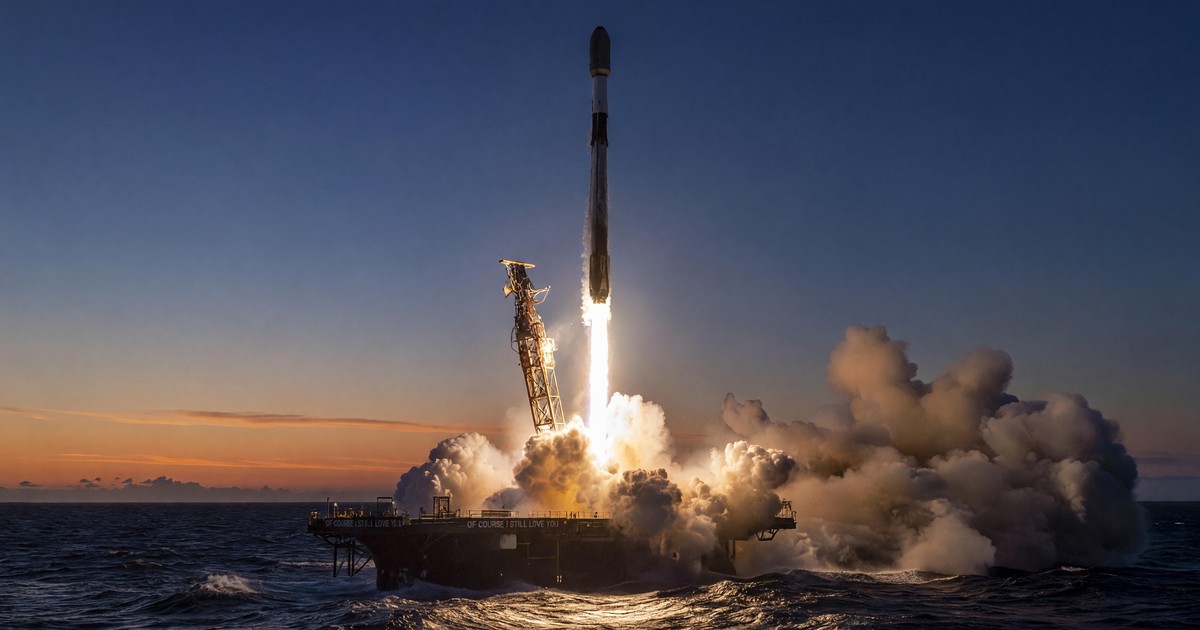
When SpaceX began landing Falcon 9 first stages in 2015, the company’s stated ambition was a booster that could fly many times with minimal refurbishment between flights. At the time, “many times” was an undefined aspiration. Nearly a decade later, individual Block 5 boosters have exceeded 20 successful reflights, with some approaching 25. That number has moved from milestone to routine — and the implications for launch economics, the competitive landscape, and the broader question of what reusability actually delivers deserve a closer look.
What Block 5 Changed
Falcon 9 went through four major hardware iterations before Block 5 entered service in 2018. The earlier versions were reusable in principle — SpaceX recovered and reflew several — but each reflight required significant inspection and refurbishment. The economics were real but limited, and the turnaround time between flights was measured in months.
Block 5 was designed from the outset around rapid reusability. The changes were incremental across dozens of subsystems rather than any single revolutionary component: upgraded Merlin 1D engines with improved thermal protection, titanium grid fins that eliminate the need to replace them between flights, landing legs with faster deploy sequences, and materials selections throughout the structure optimized for repeated thermal cycling. The cumulative effect was a vehicle that could, in principle, be returned to flight within days of landing rather than months.
The operational reality has tracked that design intent. SpaceX has demonstrated turnaround times as short as two weeks for high-demand boosters, and the inspection and refurbishment procedures have become progressively more streamlined as the team has accumulated data on actual wear patterns versus the conservative assumptions built into early protocols.
The 20-Flight Threshold
Why does 20 flights matter as a milestone?
When Block 5 entered service, SpaceX’s stated design target was 10 flights with only minor refurbishment, and up to 100 flights with more substantial work in between. That 10-flight baseline was the threshold at which the reusability economics became clearly favorable — below 10 flights, the per-flight savings from recovery are real but modest relative to the capital cost of the booster. Above 10 flights, the amortization math changes substantially.
Crossing 20 flights with individual boosters indicates that the actual wear curve is shallower than the conservative design target predicted. Structure that was designed for 10 refurb-free flights is accumulating 20 without entering the refurbishment regime — or with only minor work between flights. That gap between design target and operational performance is where the real efficiency gains live.
It also validates the inspection-based certification approach. Rather than mandating replacement of specific components at fixed flight intervals, SpaceX uses inspection data to determine when components actually need attention. The operational data from the 20+ flight boosters is building the actuarial table for Falcon 9 reusability — data that has no equivalent in any prior launch vehicle program.
What the Economics Actually Look Like
The reusability case for Falcon 9 is often presented in simple terms: recovering the booster avoids building a new one, so each reflight is dramatically cheaper. The reality is somewhat more textured.
A new Falcon 9 first stage costs roughly $30–$35 million to manufacture, representing about half of the total vehicle cost. Recovery and refurbishment costs are not public, but industry analysts estimate them at $3–$5 million per cycle for a high-confidence Block 5 turnaround. At 20 flights from a single booster, the manufacturing cost is amortized across 20 missions rather than one — a saving of roughly $28–$30 million in first-stage manufacturing per flight versus an expendable vehicle.
That math is what underlies Falcon 9’s pricing. SpaceX offers Falcon 9 launches at prices that competitors with expendable vehicles cannot consistently match while remaining profitable. The reusability margin is the source of that competitive position, and the marginal economics improve with each additional flight on a booster.
The caveat is that this assumes high demand and high launch cadence. The economics of reusability are front-loaded: recovery infrastructure, refurbishment facilities, inspection overhead, and the capital cost of maintaining a booster fleet all exist before the first reflight. At low cadence, those fixed costs erode the per-flight savings. SpaceX’s position is advantaged precisely because its launch cadence — approaching and exceeding 100 launches per year — justifies that infrastructure at scale.
Is There a Practical Upper Limit?
The 20-flight milestone raises the question of whether there is an operational limit on reflights, and if so, where it falls.
The honest answer is that the industry does not know yet, because no other vehicle program has accumulated comparable data. The structural fatigue models for reusable launch vehicles are based on conservative engineering assumptions calibrated against very limited operational experience. Falcon 9 Block 5 is, in a real sense, writing the manual.
What SpaceX’s data will eventually reveal is the actual failure mode distribution — which components wear out first, at what flight count, and whether failure modes cluster (suggesting a finite operational limit) or spread (suggesting an indefinite operational life with replacement of specific components). The landing legs, for instance, are replaced more frequently than the primary structure. The grid fins are more durable. The engines accumulate time in their own way.
The broader regulatory and policy environment for commercial launch operators is covered in the 2026 commercial space launch regulatory outlook. For national security payloads, the Space Force has established its own certification requirements for reflown boosters. The current certification allows a certain number of flights before a booster is no longer eligible for the highest-classification missions — not because the booster is necessarily unsafe, but because the national security community imposes more conservative postures. That policy will likely evolve as the data accumulates.
Implications for the Competitive Landscape
Falcon 9’s reusability economics create a structural cost advantage that new entrants are attempting to replicate rather than compete around.
Blue Origin’s New Glenn is designed for first-stage reusability from the outset. ULA’s Vulcan Centaur is not reusable in its current configuration, though the SMART reuse concept — recovering the engine section — is on the long-term roadmap. Rocket Lab has implemented first-stage recovery on Electron, its small-lift vehicle, after initially flying it expendably.
None of these programs has yet accumulated the flight data that Block 5 has. The reusability claims for New Glenn — similar to where Falcon 9 was in 2016 — will be validated or revised over the next several years of operational flight. The structural advantage that SpaceX holds is not just the technology; it is the data. A booster with 20+ flights in its history carries operational knowledge that a new vehicle, regardless of its design, cannot acquire except through flying.
For Starship, SpaceX’s next-generation vehicle, the reusability ambitions are even more aggressive — full reuse of both the booster and upper stage, with a target operational cadence that makes Falcon 9’s tempo look modest. Whether those targets are achievable on the timeline SpaceX suggests is a separate question, but the organizational experience being built through Falcon 9 Block 5 operations is the foundation on which Starship’s reusability program will be built.
What This Means for Launch Customers
For commercial and government launch customers, the 20-flight milestone has concrete implications.
The most direct is continued competitive pricing. As long as Block 5 boosters accumulate flights and the per-flight amortization cost falls, SpaceX has pricing flexibility that expendable competitors lack. Whether the company passes all of that margin to customers or retains it depends on competitive pressure — and the competitive picture, while improving with New Glenn and Vulcan’s entry, remains asymmetric.
The secondary implication is manifest confidence. A booster with 20 successful flights is not a higher-risk vehicle than a new one — the operational data suggests the opposite. Customers who might have been skeptical of flying on a reflown booster in 2016 have largely accepted the practice as routine. Flight heritage is now considered a positive attribute rather than a caveat.
The tertiary implication is launch availability. A fleet of reusable boosters, each capable of rapid turnaround, gives SpaceX scheduling flexibility that a manufacturer-dependent model cannot match. A customer with an urgent manifest need — a satellite anomaly requiring replacement, a time-sensitive science mission — finds SpaceX’s manifest more accessible than a competitor who must manufacture a new vehicle for each flight.
Frequently Asked Questions
How many flights has the most-flown Falcon 9 booster completed?
As of mid-2024, several Block 5 first stages had exceeded 20 flights, with the highest-flight-count boosters approaching 25 reflights. SpaceX publishes the flight history for each booster, and the highest-use vehicles have become benchmarks for reusability discussions across the industry.
Does SpaceX charge less for missions on a reflown booster?
SpaceX’s public pricing does not formally distinguish between new and reflown first stages — the listed price is for the launch service, not the specific hardware configuration. In practice, SpaceX has used reflight availability as a scheduling tool, offering earlier manifest slots on reflown vehicles. Some customers on fixed-price contracts have received pricing adjustments, but this is not a published policy.
What components are replaced between Block 5 reflights?
SpaceX does not publish detailed refurbishment bills of material, but the pattern from public statements and observer accounts suggests that Merlin engine refurbishment (inspection, seal replacement) is the most consistent work scope, along with landing leg replacement at intervals and periodic inspection of the primary structure and avionics. Grid fins and the interstage have shown durability well beyond initial expectations.
Why can’t Vulcan Centaur or New Glenn match Falcon 9’s reusability economics yet?
Both vehicles are earlier in their operational histories. Reusability economics improve as flight data accumulates and refurbishment procedures are optimized. New Glenn is designed for first-stage reuse and will develop its own flight data over the next several years. Vulcan’s SMART reuse concept, if implemented, would recover only the engine section rather than the full first stage — a different economic model than full stage recovery.
What does “design life” mean for a reusable booster?
Design life is the number of cycles for which the vehicle’s structure was analyzed and tested under the design specifications. For Block 5, the stated design life was 10 flights with minor refurbishment, 100 flights with more substantial work. Crossing 20 flights without entering the refurbishment regime indicates the actual wear rate is lower than the conservative design assumption — a common outcome when engineering assumptions are validated against real operational data.
How does the Space Force’s reflight policy affect national security customers?
The Space Force certifies launch vehicles for national security missions, and its certification criteria include flight count thresholds for reflown boosters. The specific thresholds are not fully public, but the policy reflects the national security community’s more conservative risk posture. As operational data on high-flight-count boosters accumulates, the policy has evolved and is likely to continue evolving.
Further Reading from Authoritative Sources
- FAA Office of Commercial Space Transportation — Launch Licensing and Safety Data — the FAA’s commercial space office publishes annual commercial space transportation forecasts and launch activity data relevant to market-level reusability trends.
- NASA Technical Reports Server — Launch Vehicle Reusability Studies — the NASA technical library contains historical and current research on reusable launch vehicle structures, fatigue analysis, and inspection methodologies applicable to understanding Falcon 9’s operational approach.