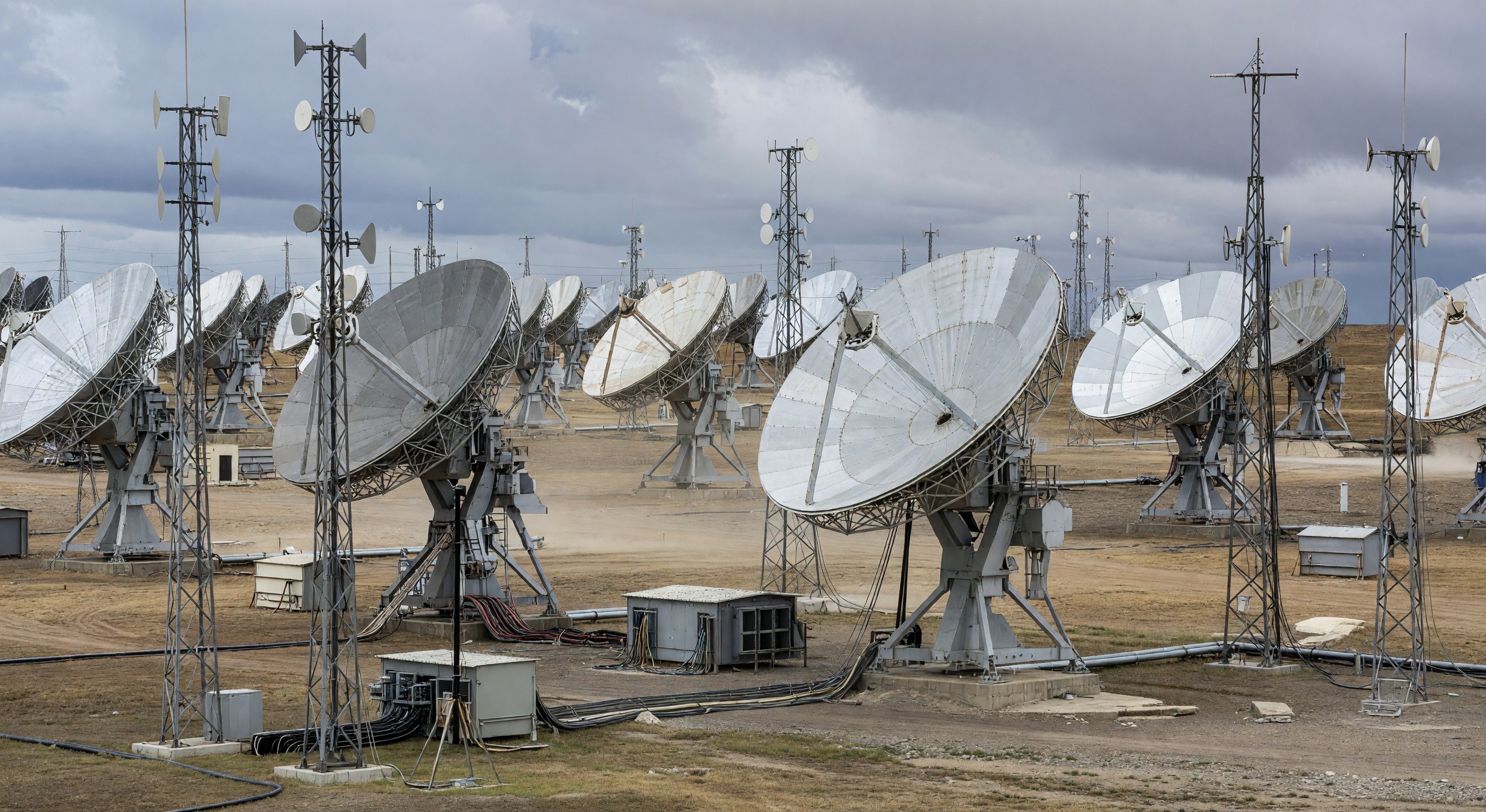
The commercial satellite broadband race is often framed as an engineering competition — who can put the most satellites in orbit fastest, who can reduce terminal costs to consumer levels, who can deliver the lowest latency. Those are real differentiators. But underneath the engineering contest is a regulatory one, and the contested resource at the center of it is not rocket propellant or fairing volume. It is radio spectrum.
Spectrum — the range of electromagnetic frequencies used for wireless communication — is a finite public resource managed in the United States primarily by the Federal Communications Commission for commercial purposes and by the National Telecommunications and Information Administration for federal government uses. The allocation of that spectrum, the licensing of specific frequency bands to specific operators, and the international coordination of those licenses are among the most consequential regulatory decisions affecting the commercial satellite industry.
How the FCC Licenses Satellite Spectrum
The FCC’s authorization process for satellite operations is governed by Part 25 of the commission’s rules, which covers satellite communications broadly. An operator seeking to use spectrum for a new satellite constellation must submit a license application identifying the frequencies requested, the orbital parameters of the proposed system, the power levels and interference characteristics of the proposed transmissions, and the service area.
The FCC’s Space Bureau — reorganized from the former International Bureau’s satellite division in recent years — reviews these applications against the commission’s rules and the international framework established by the International Telecommunication Union. The ITU maintains the Radio Regulations, which govern frequency allocation globally and establish the coordination procedures that national regulators must follow when assigning spectrum to systems that operate across national borders.
A key feature of the FCC licensing process for non-geostationary orbit satellite constellations is the milestone requirement. An operator that receives a license is required to deploy a certain percentage of its licensed constellation by specific dates — otherwise the license lapses. This milestone system was introduced to prevent spectrum warehousing: the practice of obtaining licenses for large constellations without the financial resources or genuine intent to build them, thereby blocking competitors from the same frequencies.
Why Spectrum Allocations Create Competitive Dynamics
The spectrum bands used by commercial satellite broadband systems — primarily Ku-band (12–18 GHz), Ka-band (26.5–40 GHz), and increasingly V-band (40–75 GHz) — are shared among multiple operators who must coordinate to avoid harmful interference. This coordination requirement creates a competitive dynamic that differs from other infrastructure industries.
When SpaceX’s Starlink, Amazon’s Project Kuiper, and other constellation operators all seek access to the same frequency bands, the licensing and coordination framework determines who can operate where, at what power levels, and with what geographic restrictions. Gaining access to a desirable frequency band, and protecting that access against later entrants, is a strategic objective with long-term revenue implications.
The FCC’s “first-in-time” coordination framework generally gives priority to operators who reach specific deployment milestones first — a policy that creates incentives for rapid constellation deployment even when business models are not yet fully validated. The rush to launch large numbers of satellites is partly an engineering race and partly a spectrum positioning strategy.
SpaceX’s Starlink has been particularly aggressive in this regard, deploying thousands of satellites across Ku and Ka bands while simultaneously petitioning the FCC for access to additional bands and seeking coordination agreements internationally. Amazon’s Project Kuiper, which began launching test satellites in 2023 and began volume deployment in 2024, faces a spectrum landscape partially shaped by the access Starlink has already established.
The International Coordination Framework
Domestic FCC licensing is only part of the picture. Satellites operate globally, and the frequencies they use affect — and are affected by — operators in other countries. The International Telecommunication Union’s Radio Regulations establish the coordination procedures that govern how national administrations interact when their satellite systems share frequencies.
Under the ITU framework, administrations file their satellite network coordination requests through the ITU’s Radiocommunication Bureau. The ITU maintains a Master International Frequency Register that records the priority of filed networks — earlier-filed networks generally have higher coordination priority, creating another first-mover incentive in the international arena.
The coordination process is complex and often contentious. When two operators’ satellites would use overlapping frequency bands in overlapping geographic areas at overlapping power levels, they must coordinate to demonstrate that each system can operate without causing harmful interference to the other. Coordination negotiations between the administrators of competing national systems (often proxies for the commercial operators involved) can take years and may require power level adjustments, geographic restrictions, or technical modifications.
For U.S. commercial operators, the FCC files coordination data with the ITU on their behalf, and the State Department manages the diplomatic dimensions of coordination disputes. Operators in this market are, by necessity, participants in an international regulatory process even when they experience it primarily through their domestic FCC licensing.
Non-Geostationary Orbit Constellations and Spectrum Sharing
The growth of large LEO constellations has created novel spectrum challenges that the ITU framework was not designed for. The Radio Regulations were developed primarily with geostationary orbit satellites in mind — fixed-position satellites that share spectrum by being assigned to specific orbital slots at defined longitudinal positions. A GEO satellite at 101° West uses a defined set of frequencies at that position, and interference calculations can be done straightforwardly.
Non-geostationary orbit constellations are constantly moving, covering different parts of the Earth at different times, and potentially affecting different numbers of other satellites at different moments. The ITU’s non-geostationary satellite orbit coordination procedures were revised in recent decades to address this, but the rules are still evolving to keep pace with the scale of current and planned constellations.
One specific regulatory mechanism that has been contentious is the ITU’s equivalent power flux-density (EPFD) limits for non-geostationary constellations operating in bands also used by geostationary satellites. These limits cap how much interference a LEO constellation can cause to GEO operators below. Operators of large LEO constellations have argued that some EPFD limits are unnecessarily restrictive given the technical realities of modern satellite design; GEO operators have argued that relaxing them would degrade the usability of their allocations.
The FCC has periodically updated its own rules relating to EPFD and coordination, and the debates at the domestic level mirror those at the ITU. How those debates resolve will affect the interference environment that any large LEO constellation must navigate.
Spectrum Allocation for Earth Observation and Other Satellite Services
Commercial broadband attracts the most attention, but spectrum management affects every category of commercial satellite operation, including Earth observation, maritime communications, direct-to-device cellular, space-to-space links for constellation mesh networking, and satellite telemetry, tracking, and command.
Earth observation satellites use specific frequency bands for downlinking imagery and data — bands that must be coordinated with other users of those frequencies. The National Oceanic and Atmospheric Administration, which licenses commercial remote sensing systems in the United States, works with the FCC and NTIA to ensure that Earth observation operators have access to the spectrum they need for data downlinks without interfering with other services.
Direct-to-device satellite services, which allow satellite signals to reach standard mobile phones without specialized terminals, are an emerging use case that requires access to the same frequency bands used by cellular networks on the ground. The FCC has authorized SpaceX and T-Mobile, and other operator pairs, to conduct supplemental coverage from space services using licensed cellular spectrum from terrestrial carriers. This regulatory framework is novel and evolving, with implications for how satellite and cellular services converge.
What the Policy Debate Looks Like in 2024
The competition between the two leading broadband constellation operators is examined in detail in the Starlink vs. Amazon Kuiper analysis. The spectrum policy debate in the commercial satellite industry as of 2024 has several active fronts.
Congestion in high-value bands is the background condition. As more operators receive licenses for large constellations, the practical question of whether available spectrum can accommodate all of them is becoming more concrete. Operators that received their licenses earlier and deployed quickly hold structural advantages, while later entrants face a more congested access environment.
V-band spectrum is an area of increasing interest. The higher frequencies offer more raw bandwidth than Ku or Ka, but the propagation characteristics — higher atmospheric absorption, especially in rain — make them more technically challenging for consumer broadband services. Several operators have obtained FCC licenses for V-band systems, and the development of ground terminals capable of working reliably at V-band is an active engineering problem.
The FCC’s spectrum auction model, used primarily for terrestrial wireless, has not been applied to satellite spectrum in the same way. Satellite frequency assignments are not auctioned — they are licensed under the coordination framework based on technical merit and ITU procedures. Whether that should change, and whether market mechanisms should play a more direct role in allocating satellite spectrum, is a policy question with advocates on both sides.
Frequently Asked Questions
What frequencies do commercial satellite broadband systems use?
The major commercial LEO broadband constellations primarily use Ku-band (12–18 GHz) and Ka-band (26.5–40 GHz) frequencies for user links — the connections between satellites and customer terminals. Higher-frequency V-band (40–75 GHz) is licensed by some operators for future systems with more bandwidth capacity.
Does the FCC charge for satellite spectrum licenses?
Satellite spectrum licenses are issued by the FCC through a regulatory process based on technical coordination and interference analysis, not through competitive auctions. There are application fees and other regulatory fees associated with licensing, but the spectrum access itself is not sold at auction the way terrestrial wireless spectrum is.
What is a milestone requirement and how does it affect satellite operators?
FCC milestone requirements mandate that an operator with a non-geostationary satellite license deploy a specified percentage of its licensed constellation by defined dates. Failure to meet milestones results in automatic termination of the license for the undeployed portion. Milestones were introduced to prevent spectrum warehousing and encourage genuine deployment.
What is the ITU and why does it matter for U.S. satellite operators?
The International Telecommunication Union is a United Nations specialized agency that manages the Radio Regulations — the international treaty framework governing spectrum use globally. U.S. satellite operators must coordinate their systems through ITU procedures to protect their frequency access internationally and to avoid harmful interference with operators in other countries.
How do non-geostationary satellite constellations create new coordination challenges?
Unlike geostationary satellites, which remain at fixed orbital positions, LEO satellites move continuously across the sky. This makes interference calculations more complex, as the relative geometry between satellites changes constantly. The ITU’s coordination framework for non-geostationary systems has been updated over time but continues to evolve as constellation scales increase.
What is direct-to-device satellite service and how is it regulated?
Direct-to-device services allow satellite signals to connect directly to standard mobile phones using spectrum licensed to terrestrial cellular carriers. The FCC has authorized supplemental coverage from space arrangements where satellite operators use terrestrial carrier spectrum under coordination agreements. This regulatory framework is new and the FCC continues to refine the rules governing it.
Further Reading from Authoritative Sources
- FCC Space Bureau — Satellite Licensing and Spectrum Resources — the FCC’s satellite licensing office publishes rule proceedings, authorization databases, and policy documents covering all aspects of commercial satellite spectrum management.
- NOAA Office of Space Commerce — Satellite Coordination Policy — NOAA’s space commerce office provides perspective on the intersection of commercial remote sensing, Earth observation spectrum, and the U.S. government’s role in commercial space regulatory coordination.