Returning a spacecraft from orbit requires surviving temperatures that exceed the surface temperature of the Sun. The kinetic energy of an orbital-velocity vehicle — moving at roughly 7.8 kilometers per second in low Earth orbit — must be converted to heat during atmospheric reentry, and that heat must be directed away from the vehicle’s structure and payload. The engineering systems that accomplish this, broadly called thermal protection systems, are among the most demanding in aerospace.
For expendable vehicles, thermal protection is a one-way problem: design a system that survives reentry once, deliver the payload or crew, discard the vehicle. For reusable vehicles, the requirement changes fundamentally. The thermal protection system must survive the reentry environment and then be ready to do it again with minimal refurbishment. That constraint drives the technology toward very different solutions than the expendable case.
The evolution of reusable thermal protection from the Space Shuttle to Starship to current capsule designs illustrates how the engineering trade space has shifted as the commercial industry’s priorities have clarified.
The Space Shuttle’s Approach: Rigid Ceramic Tiles
The Space Shuttle’s thermal protection system was the first practical implementation of a reusable heat shield for an orbital vehicle. The orbiter’s surfaces were covered by approximately 24,000 individual tiles of varying sizes and compositions, each bonded to the vehicle’s aluminum skin.
The tiles were made from silica fiber — essentially very high-purity glass foam — which is an extraordinarily effective thermal insulator. Despite the tiles reaching temperatures of 1,260°C during reentry, an uncoated tile’s interior remained cool enough to hold in a bare hand within moments. The tile material re-radiates absorbed heat efficiently and does not conduct it into the vehicle structure.
The system worked, but it was expensive and fragile. Each tile had to be inspected individually between flights, replaced if cracked or damaged, and bonded precisely to the underlying skin. The tile bonding and inspection process dominated the orbiter’s processing time between flights and was a major driver of Shuttle’s high per-flight cost. The loss of Columbia in 2003, caused by tile damage from foam insulation debris during launch, demonstrated the system’s vulnerability to impact damage.
The Shuttle’s tile system was never designed for the rapid reusability that commercial launch requires. Its refurbishment requirements assumed a government program with months between flights and a large workforce performing meticulous individual tile inspection. That model is incompatible with commercial launch economics.
Ablative Shields: The Capsule Approach
An alternative to tiles — one used by Mercury, Gemini, Apollo, and now modern commercial crew capsules — is the ablative heat shield. Rather than re-radiating heat from a refractory surface, an ablative shield absorbs heat by charring and vaporizing its outer layers. The pyrolysis gases generated by the ablation process create an insulating boundary layer in the shock layer, further reducing heat transfer to the vehicle.
The ablative approach has significant advantages for crewed capsules. The shield is robust to impact damage in a way that rigid tiles are not — there is no bond line to fail, and minor impacts are self-healing in the sense that they just ablate more material. The shield doesn’t require individual tile bonding inspection. And the ablative process is physically straightforward to analyze and test, giving designers high confidence in the system’s performance envelope.
The limitation is that ablation consumes material. Each reentry erodes some of the shield. For an expendable capsule — which is discarded after one use — this is not a problem; the shield is sized for the maximum reentry environment, and what remains after use doesn’t matter. For a reusable capsule that reenters multiple times, the shield must either be replaced between flights (manageable, but adds cost and turnaround time) or be sized to last multiple reentries without replacement.
SpaceX’s Dragon capsule, which has completed multiple crewed and cargo reentries, uses a PICA-X ablative heat shield — a variant of Phenolic Impregnated Carbon Ablator (PICA) developed originally at NASA’s Ames Research Center. PICA-X’s formulation is optimized for multiple reentries with a single shield, reducing (though not eliminating) the shield replacement requirement between flights. Boeing’s Starliner uses a different ablative formulation, Avcoat, the same basic material used for Apollo.
The critical metric for reusable ablative shields is recession rate — how much material is consumed per reentry — and whether the margin between new thickness and minimum serviceable thickness allows for the intended number of reentries before shield replacement.
Starship’s Novel Approach: Metallic Tiles on Stainless Steel
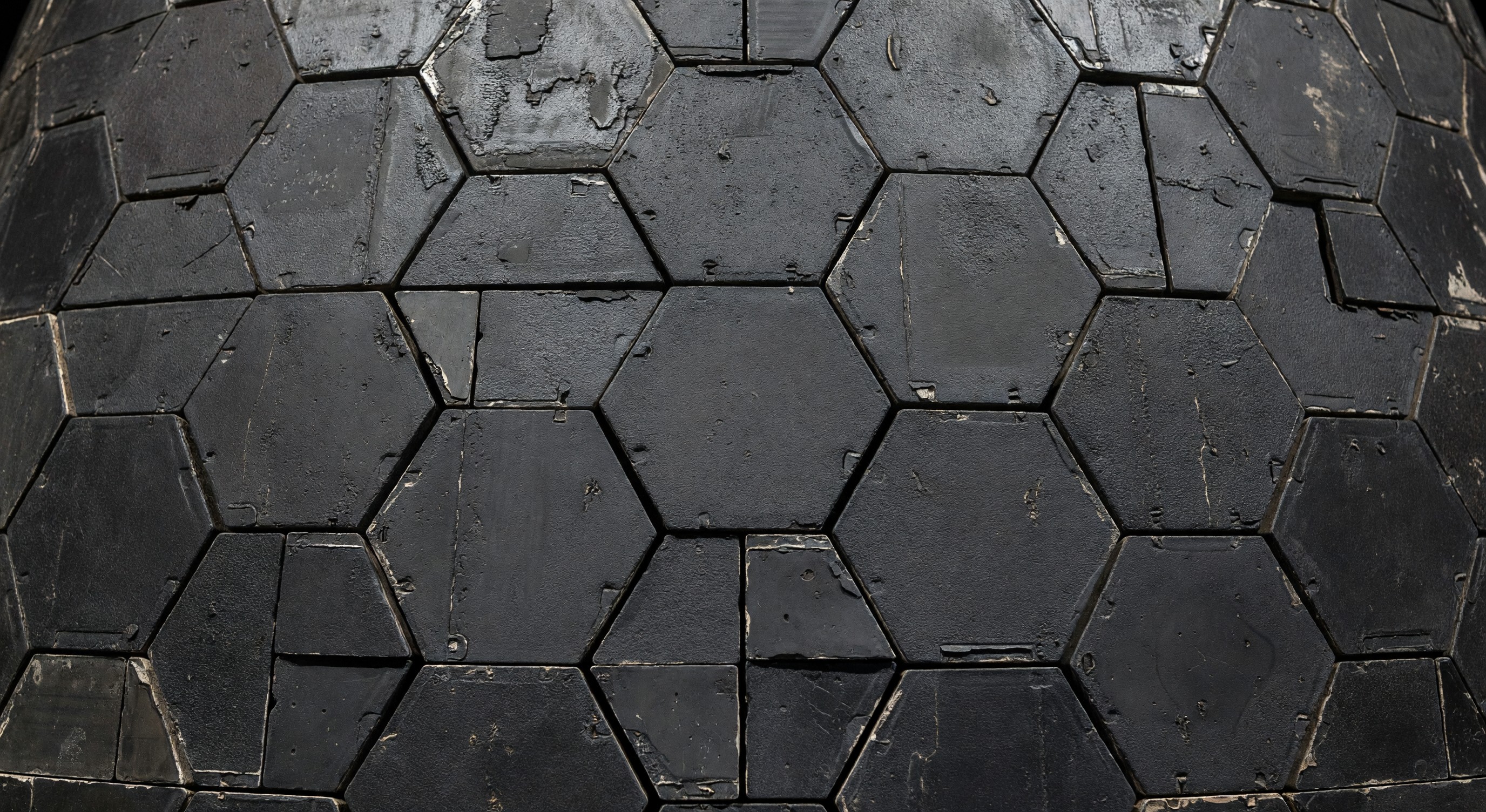
SpaceX’s Starship takes a fundamentally different approach to thermal protection than either tiles on aluminum or ablative capsule shields. The vehicle is made of stainless steel rather than aluminum — a choice made partly because stainless steel retains structural strength at higher temperatures, reducing the thermal protection burden — and its windward surface uses a pattern of hexagonal tiles made from a silica-based ceramic material similar in concept to Shuttle tiles but different in attachment method.
Starship’s tiles attach by a pin system rather than bond line adhesive, a departure from the Shuttle approach designed to improve repairability. A tile that fails can potentially be replaced by removing its attachment pins and inserting a replacement rather than debonding and rebonding. The practical significance of this improvement depends on how tile damage actually presents in operational use, which the program is learning through flight experience.
The stainless steel substrate means that even areas where tiles are missing or damaged have more intrinsic heat resistance than Shuttle’s aluminum skin did. The vehicle is designed to survive limited tile loss without catastrophic consequence — the stainless steel acts as a backup thermal layer in a way that aluminum cannot.
For Starship’s descent and landing, the vehicle uses a belly-flop orientation during atmospheric descent — maximum cross-section, high drag, slow descent — rather than the high-angle attack reentry profile of capsules. This creates a different thermal environment than capsule reentry: more distributed heating over a larger surface, lower peak temperatures at any single point, but longer duration exposure. The tile system is sized for this specific thermal profile.
Active Cooling and the Frontier of Reusable TPS
Beyond passive thermal protection — tiles that re-radiate heat, ablatives that char away — there are concepts for active cooling systems that could enable even more aggressive reusability.
SpaceX has briefly referenced a transpiration cooling concept for specific areas of Starship — pumping propellant through pores in the surface to create a protective film over the hottest zones. This concept has precedents in rocket engine throat cooling (where coolant flows through the throat and nozzle wall) and in some experimental hypersonic research vehicles. Whether it is practical for the large surface areas of an operational reusable vehicle is a question the program’s flight experience will eventually answer.
NASA has researched advanced carbon-carbon composite materials and ceramic matrix composites for thermal protection applications. Carbon-carbon is already used on Shuttle and subsequent vehicles for the most critical high-temperature zones — the nose and leading edges. Its high strength and heat resistance make it suitable for areas where tile or ablative approaches can’t survive the thermal environment.
Ultra-high-temperature ceramics (UHTCs) represent another research frontier — materials based on hafnium boride, zirconium diboride, and similar compounds that maintain structural integrity at temperatures above 2,000°C, far beyond what silica-based tiles can handle. These materials have applications for hypersonic vehicle leading edges and scramjet combustors, though manufacturing them at the scale required for a large reusable vehicle remains challenging.
What Thermal Protection Determines for the Commercial Industry
The propulsion choices that drive the reusable launch architecture — particularly the shift to methane engines — are analyzed in the Raptor and BE-4 methane engine comparison. The thermal protection system’s maturity is one of the limiting factors on reusability economics. A heat shield that requires significant refurbishment after every flight — like Shuttle tiles — adds cost and turnaround time that erodes the economic case for reuse. A heat shield that can be reflown many times with minimal inspection and replacement is a structural enabler of the flight rates that reusability economics require.
Dragon’s PICA-X shield and SpaceX’s operational experience with multiple crewed reentries represents meaningful progress toward the multi-reuse goal for capsule TPS. Starship’s tile system is earlier in its operational validation, with flight data from integrated flight tests beginning to characterize actual tile performance versus the design predictions.
For the launch industry, the thermal protection technology on each vehicle is a significant variable in the actual cost curve of reusability at scale. Vehicles whose TPS refurbishment costs are low and whose tile or shield replacement intervals are long will achieve better economics than vehicles where TPS maintenance is a dominant operational cost. This is a competition that plays out over hundreds of flights, not on paper specifications.
Frequently Asked Questions
What temperature does a reentry vehicle experience?
During atmospheric reentry from orbital velocity, the shock layer ahead of the vehicle can reach temperatures of 6,000°C or higher. The vehicle surface sees lower temperatures — typically 1,200–1,600°C for a typical reentry trajectory — because the shock standoff distance reduces direct conductive heat transfer. The specific temperatures depend on vehicle geometry, reentry angle, and velocity.
Why did SpaceX use stainless steel for Starship instead of aluminum?
Stainless steel retains structural strength at higher temperatures than aluminum, reducing the thermal protection burden for the vehicle structure. It is also less expensive per kilogram and easier to weld at scale than the aerospace aluminum alloys used in most launch vehicles. The mass penalty of stainless steel versus aluminum is partially offset by the reduced TPS requirements it enables.
How is PICA-X different from the Apollo ablative shield?
Apollo used Avcoat, a fiberglass honeycomb filled with a silicone compound that ablates during reentry. PICA-X is SpaceX’s proprietary formulation of Phenolic Impregnated Carbon Ablator, originally developed by NASA. PICA-X is designed for lower recession rates — slower material consumption during reentry — enabling multiple reentries before shield replacement.
What is transpiration cooling and could it replace tiles?
Transpiration cooling pumps a coolant (potentially propellant) through a porous surface, creating a protective film that absorbs and carries away heat. It is used in rocket engine cooling and has been studied for hypersonic vehicles. Whether it is practical at the scale of a large reusable orbital vehicle — requiring uniform flow through an enormous surface area — is an open research question.
Why were Space Shuttle tiles so expensive to maintain?
Shuttle’s approximately 24,000 individual silica tiles were each bonded to the vehicle’s aluminum skin with precision adhesive, required individual inspection after each flight, and were fragile to impact damage. The combination of high part count, individual inspection burden, and bond-line vulnerability made the tile processing a major driver of Shuttle’s per-flight cost. Modern systems attempt to reduce this burden through improved attachment methods and material robustness.
How does the thermal environment differ for Starship versus a capsule like Dragon?
Dragon reenters at high angle of attack with the heat shield directly facing the reentry heating — concentrated, high peak heat flux over a shorter duration. Starship reenters in a belly-flop attitude with distributed heating over a much larger surface area and longer duration exposure. The different thermal profiles drive different TPS design requirements even if both vehicles survive similar entry velocities.
Further Reading from Authoritative Sources
- NASA Technical Reports Server — Thermal Protection Systems Research — NASA’s technical library contains decades of research on ablative materials, ceramic tiles, and advanced TPS concepts including PICA development history and Shuttle TPS lessons learned applicable to understanding modern reusable systems.
- NASA Ames Research Center — Entry Systems and Technology — NASA Ames is the primary center for thermal protection system research, developing and testing materials used in Dragon, Orion, and other entry vehicles, with published research on material performance and reuse characteristics.