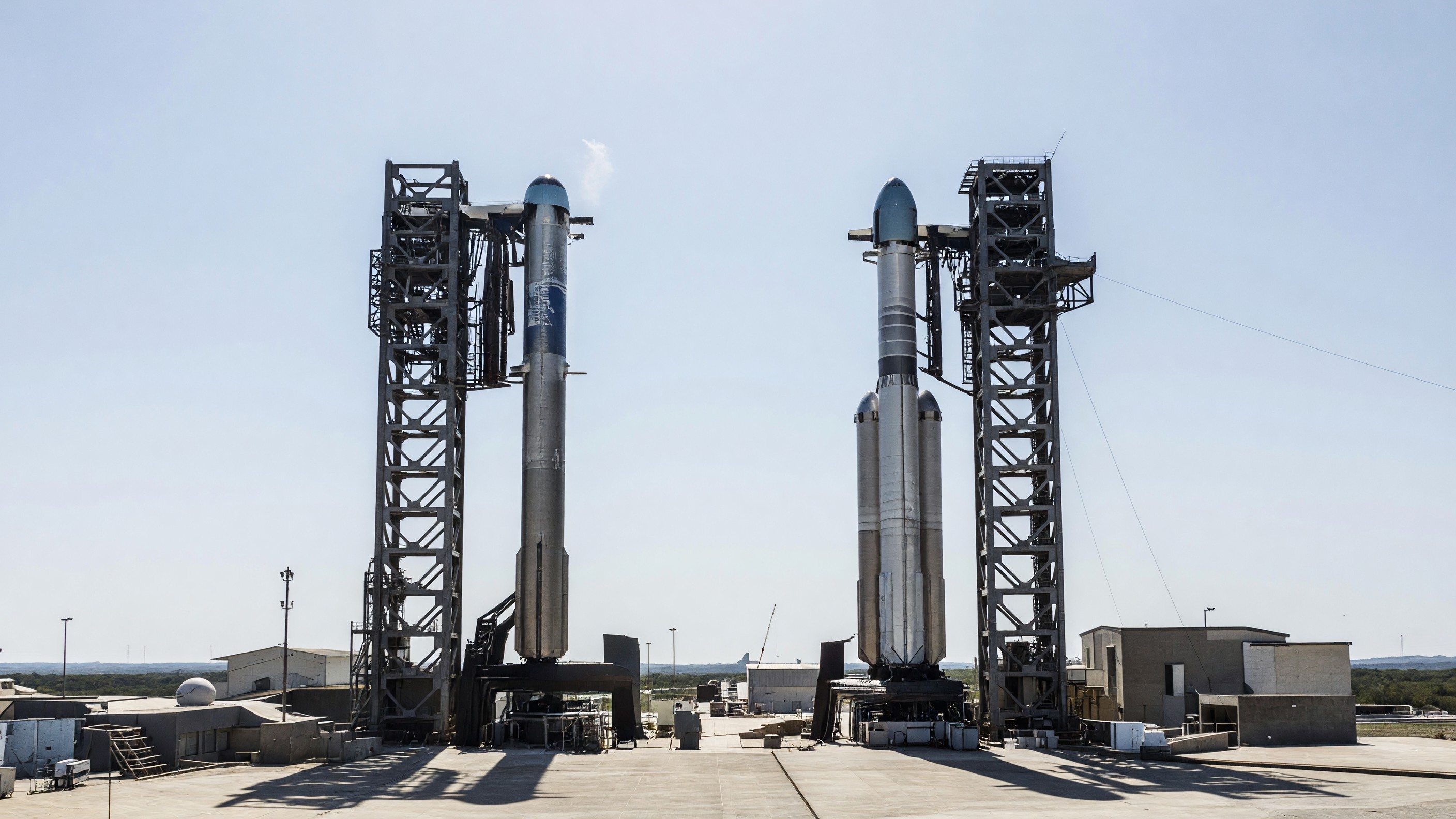
For most of the past decade, the U.S. orbital launch market has been a story dominated by a single company. SpaceX’s Falcon 9 carried the bulk of the country’s commercial, civil, and increasing portions of the national security manifest. The 2025 calendar year has begun to change that picture — not because SpaceX’s dominance has weakened, but because two long-awaited new vehicles have finally entered the market: Blue Origin’s New Glenn and United Launch Alliance’s Vulcan Centaur.
Both vehicles have flown their inaugural missions. Both are now beginning to compete for commercial and government payloads. Whether they can sustainably challenge SpaceX’s pricing and cadence — or whether they will instead occupy specific niches where their architectures are advantaged — is the question that will shape the U.S. launch market for the rest of the decade.
New Glenn: Blue Origin’s Long Road to Orbit
Blue Origin’s New Glenn first reached orbit in early 2025, ending a development program that had stretched across roughly a decade and several public schedule slips. The vehicle is a two-stage heavy-lift launcher with a 7-meter payload fairing — significantly wider than Falcon 9’s 5.2-meter fairing — and a first stage powered by seven BE-4 methane-fueled engines.
The BE-4 is itself a significant story. Blue Origin developed the engine not only for New Glenn but also as the first-stage powerplant for ULA’s Vulcan Centaur, making BE-4 the common propulsion element between the two new American heavy-lift vehicles. The engine’s development took longer than originally planned, and engine availability was a substantial factor in both vehicles’ timelines.
New Glenn’s first stage is designed for recovery and reuse, landing on a downrange vessel in the Atlantic. The first flight’s recovery attempt did not succeed, though the upper stage successfully delivered its demonstration payload to orbit. Recovery is expected to mature over subsequent flights, following a learning curve similar to what SpaceX experienced with early Falcon 9 landing attempts. Blue Origin’s New Glenn page describes the vehicle’s capabilities and intended operational profile.
The vehicle’s payload capacity positions it in the heavy-lift category, with a larger fairing volume than Falcon 9. That fairing size is a meaningful advantage for certain payload classes — particularly large national security satellites, commercial communications spacecraft with extended antennas, and potentially the Blue Moon lunar lander variants Blue Origin is developing for NASA’s Human Landing System contract.
Vulcan Centaur: ULA’s Transition Vehicle
United Launch Alliance’s Vulcan Centaur first flew on January 8, 2024, carrying Astrobotic’s Peregrine lunar lander on a mission funded under NASA’s Commercial Lunar Payload Services program. The Peregrine spacecraft itself encountered a propellant leak after deployment and did not reach the Moon, but Vulcan’s performance was nominal — a successful inaugural launch for a vehicle that had been in development since the previous decade.
Vulcan’s subsequent flights, conducted as part of a Space Force certification process, demonstrated the vehicle’s performance and reliability for national security payloads. The Space Force’s certification process for new launch vehicles requires multiple successful flights before a vehicle is eligible to carry the highest-priority government payloads. Vulcan completed the required certification flights and entered operational service.
Vulcan is a transition vehicle in two senses. It replaces both the Atlas V and the Delta IV Heavy in ULA’s portfolio — vehicles that have been the workhorses of U.S. national security launch for two decades but that are being retired. Atlas V is flying the remaining missions in its inventory before exiting service. Delta IV Heavy flew its final mission in 2024. Vulcan inherits both vehicles’ roles, with a high-energy upper stage configuration that addresses the demanding trajectories that Delta IV Heavy was uniquely able to fly.
The vehicle is described in detail on ULA’s Vulcan Centaur page. It is fully expendable in its current configuration, though ULA has discussed a long-term concept called SMART reuse that would recover the engine section. SMART has not yet been implemented and is not part of the operational Vulcan configuration.
How They Compare to Falcon 9
The most important comparison is not which vehicle is technically superior — that question is poorly framed — but how each fits the market for which it was designed.
Falcon 9 is a high-cadence, partially reusable workhorse optimized for a broad range of medium-lift missions. Its first-stage reusability has driven costs down across hundreds of flights, and its operational tempo — approaching or exceeding 100 launches in recent years — is unmatched. The vehicle’s standardized payload accommodations and rideshare missions have absorbed a large share of small-satellite demand.
New Glenn is positioned as a heavy-lift complement, with a larger fairing and higher payload capacity. Its economics depend on first-stage recovery maturing — an expendable New Glenn would be much harder to price competitively against Falcon 9. The volume of its fairing creates opportunities Falcon 9 cannot easily serve, but the relatively low number of payloads requiring that volume limits the addressable market.
Vulcan Centaur is positioned for the national security and high-energy science markets, where its Centaur upper stage performance and ULA’s mission assurance reputation are genuine advantages. It is unlikely to compete with Falcon 9 on price for routine commercial missions, but in markets where the customer values capability and assurance over cost per kilogram, Vulcan is a credible alternative.
The realistic outcome is not that either New Glenn or Vulcan displaces Falcon 9 as the market leader. It is that each occupies a portion of the market where its specific characteristics matter, while Falcon 9 continues to carry the bulk of routine medium-lift demand.
What the New Entrants Mean for the Market
Three structural changes follow from New Glenn and Vulcan entering operational service.
First, customer optionality returns. For the better part of the last decade, customers who wanted U.S. domestic launch had effectively one mainstream option for many missions. With three operational providers, customers can negotiate, schedule against alternatives, and assemble manifests that are not entirely dependent on a single vehicle’s availability.
Second, national security launch is now a genuinely competitive market. The Space Force’s National Security Space Launch program has structured its procurement to maintain at least two providers, and New Glenn is on track to be added to the certified provider list as it accumulates successful flights. The result is a national security launch market with real competition, which had not been consistently true for most of the previous decade.
Third, the cadence question becomes the central one. New Glenn flew once in early 2025 with additional flights planned. Vulcan has completed its certification flights and is ramping toward operational cadence. Neither vehicle is yet flying at a rate that meaningfully challenges SpaceX’s tempo. Whether they can build to that level — and whether the supply chain, particularly BE-4 engine production, can support it — will determine whether the U.S. launch market is genuinely multi-provider or remains effectively single-provider with two specialized alternatives.
Looking Ahead
The next two years are likely to be defining for both vehicles. New Glenn needs to demonstrate consistent first-stage recovery, build flight cadence, and prove that the vehicle’s economics work at scale. Vulcan needs to continue its national security flight manifest, expand commercial bookings, and demonstrate that ULA can operate at a higher tempo than the Atlas V era.
For SpaceX, neither vehicle represents an existential competitive threat. Falcon 9’s operational position is strong — including the Block 5 reusability record now being set — and Starship’s eventual maturation would extend SpaceX’s capability further into the heavy-lift market. But the comfortable position of being the only credible domestic option for many missions is ending. The 2025 launch market is more competitive than the 2020 launch market, and that is a meaningful change regardless of who ends up flying the most rockets.
Update: for how this competitive picture actually played out through the first half of 2026 — including setbacks at both New Glenn and Vulcan — see the 2026 launch cadence mid-year scorecard.
Frequently Asked Questions
Q: When did New Glenn first reach orbit? A: Blue Origin’s New Glenn achieved orbit on its inaugural launch in early 2025. The first-stage recovery attempt on that flight did not succeed, but the upper stage successfully delivered its demonstration payload.
Q: When did Vulcan Centaur first fly? A: Vulcan Centaur’s inaugural flight took place on January 8, 2024, carrying the Astrobotic Peregrine lunar lander. Subsequent certification flights followed in 2024 before the vehicle entered national security service.
Q: How does New Glenn compare to Falcon 9 in size? A: New Glenn is a larger vehicle, with a 7-meter payload fairing compared to Falcon 9’s 5.2-meter fairing, and a heavier payload capacity to low Earth orbit. It is positioned in the heavy-lift category rather than as a direct Falcon 9 competitor.
Q: Is Vulcan Centaur reusable? A: Not in its current operational configuration. ULA has discussed a future concept called SMART reuse that would recover the engine section, but it has not been implemented. Vulcan is fully expendable today.
Q: What engine powers both New Glenn and Vulcan? A: Both vehicles use Blue Origin’s BE-4 methane-fueled engine in their first stages. New Glenn uses seven BE-4 engines; Vulcan uses two. The common propulsion element reflects a deliberate industrial decision by Blue Origin to develop BE-4 for multiple customers.
Q: Can the new entrants meaningfully challenge SpaceX? A: They can compete effectively for portions of the market where their characteristics are advantaged — fairing volume for New Glenn, high-energy capability for Vulcan. Whether either can match SpaceX’s cadence and economics at scale remains the defining question.