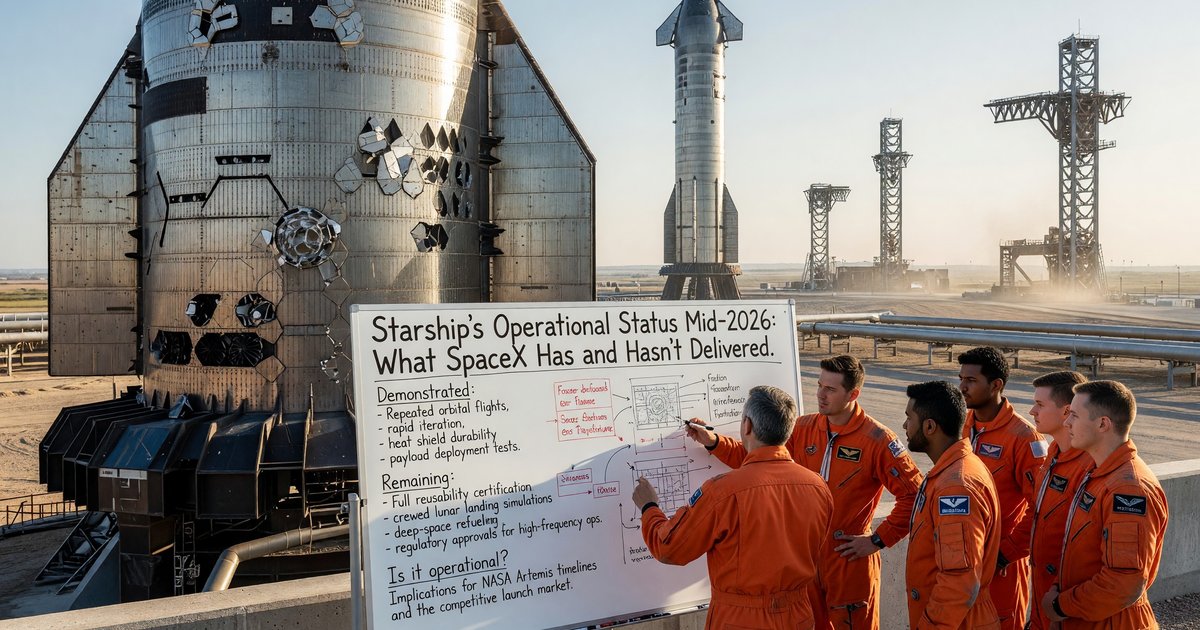
“Operational” is the most contested word in the launch industry right now, and Starship is the reason. SpaceX’s fully reusable super-heavy vehicle has flown an integrated test campaign spanning more than two years, recovered Super Heavy boosters, demonstrated payload bay operations, and moved from spectacular early failures toward something resembling routine flight. The company describes the program in operational terms. NASA’s Artemis schedule depends on it being operational in a very specific, very demanding sense. And the rest of the launch market is trying to price a future in which it actually is.
The defining question for mid-2026 is not whether Starship works — the flight record increasingly says it does — but whether it has crossed the line from successful test program to operational launch system. Those are different claims, and the distance between them matters to everyone who buys, regulates, or competes with launch services. This is an assessment of where that line actually sits as the year reaches its midpoint.
What “Operational” Means — and Why the Definition Is Doing So Much Work
For a conventional launch vehicle, operational status is reasonably easy to define: the vehicle has completed its test campaign, it flies revenue missions for paying customers, and its performance is predictable enough that customers book payloads against a published capability. Falcon 9 crossed that line years ago. Vulcan Centaur crossed it through the Space Force certification process. The standard is conservative but legible.
Starship complicates the definition in two ways. First, it is not one capability but several: an expendable-mode heavy lifter, a reusable booster system, a recoverable upper stage, an orbital propellant depot architecture, and — in its Human Landing System variant — a crewed lunar lander. Each of those capabilities matures on its own timeline. A Starship that can reliably deploy next-generation Starlink satellites is operational for that mission while remaining deeply developmental for lunar landing.
Second, SpaceX’s iterative development model deliberately blurs the test/operational boundary. The company has historically flown revenue payloads on vehicles other providers would still classify as test articles, and it improves hardware continuously rather than freezing a certified configuration. That approach served Falcon 9 well, but it means there is no single announcement, no certification ceremony, that marks the transition. Observers are left to infer operational status from behavior: flight cadence, payload manifests, and reuse statistics.
What the Flight Record Has Established
The integrated flight test campaign that began in April 2023 has, by mid-2026, established several capabilities that no longer carry meaningful technical doubt.
The first is that the full stack reaches orbit-class trajectories reliably. The failure modes that defined the early campaign — stage separation, engine-out cascades, loss of vehicle control during ascent — were progressively retired across the test flights of 2024 and 2025. Ascent is no longer the hard part.
The second is booster recovery. Super Heavy’s return-to-launch-site catch, first demonstrated in late 2024, moved from a singular engineering spectacle to a repeatable procedure across subsequent flights. Booster reuse — the single most important economic variable in the entire architecture, given that the first stage carries the large majority of the vehicle’s engines — has been demonstrated, with flown boosters returning to the flight rotation.
The third is upper-stage survivability. The ship’s controlled reentry and soft splashdown, achieved repeatedly after the heat-shield struggles of the early campaign, demonstrated that the fundamental reentry approach works, even as SpaceX continued iterating tile design and catch plans for the ship itself.
What the record has not yet established is equally important: sustained high cadence, demonstrated on-orbit propellant transfer at the scale Artemis requires, and a recurring revenue manifest of external customer payloads comparable to Falcon 9’s. SpaceX’s Starship page describes the vehicle’s intended capabilities; the gap between that description and the demonstrated flight record is precisely the gap between aspiration and operational status.
The NASA HLS Test: The Hardest Definition of Operational
The most consequential — and least forgiving — definition of Starship operational status belongs to NASA. Under the Human Landing System contract, the Starship lunar variant must carry Artemis crew from lunar orbit to the surface and back. NASA’s Human Landing System program sets out milestone gates that no amount of Starlink deployment success can substitute for: an uncrewed lunar landing demonstration, and before that, the orbital propellant aggregation campaign that the lunar mission profile requires.
Propellant transfer is the long pole. The HLS mission architecture requires launching a depot, filling it with multiple tanker flights, and transferring cryogenic propellant in orbit at a scale never previously attempted. Each element compounds the cadence question: a lunar mission is not one Starship launch but a campaign of them, flown on a schedule tight enough that boil-off losses don’t consume the margin. This is why flight rate is not a vanity metric for the program — it is a mission requirement.
NASA’s own schedule pressure cuts both ways. Artemis program timelines have moved repeatedly, and the agency has publicly tied crewed landing dates to HLS readiness. For NASA’s purposes, Starship is operational when the uncrewed demonstration landing succeeds — and by that standard, the program in mid-2026 remains developmental, whatever its other accomplishments.
What It Means for the Rest of the Market
For competitors and customers, the practical question is when Starship begins absorbing payload demand that currently flies on Falcon 9, Vulcan, New Glenn, and the medium-lift field. The honest answer is that the early operational manifest is overwhelmingly internal: next-generation Starlink satellites sized for Starship’s payload bay are the natural first cargo, just as Starlink absorbed Falcon 9’s excess capacity for years.
That internal demand is strategically important. It lets SpaceX accumulate flight heritage, reuse statistics, and cadence on its own payloads before external customers must commit. It is the same playbook that made Falcon 9’s reliability record possible — and it means that external evidence of operational maturity will lag internal reality. The market dynamics resemble the competitive landscape that emerged when New Glenn and Vulcan entered service: new capability arrives gradually, and incumbency in specific payload classes erodes slowly rather than collapsing.
The regulatory environment remains a genuine constraint on the cadence trajectory. Starship’s launch sites — Boca Chica and the Florida pads under environmental review — sit at the center of the licensing and environmental review friction that defines the 2026 regulatory landscape. A vehicle designed for airline-like operations cannot reach that tempo on a permitting framework built for a dozen launches a year, and the pace of authorization at multiple sites will shape the realized flight rate as much as hardware readiness does.
The Mid-2026 Verdict
A fair scorecard reads like this. As a flight demonstration program, Starship has delivered: ascent reliability, booster recovery and reuse, and upper-stage reentry are established. As an internal payload delivery system, it is at or near operational status, with Starlink-class missions the proving ground. As a commercial launch product for external customers, it is pre-operational — credible, but not yet booked and flown at scale. And as a crewed lunar lander, it remains a development program with its hardest demonstrations still ahead.
That mixed verdict is not a criticism; it is what the middle of a transition looks like. The claim to watch for the rest of 2026 is not SpaceX calling Starship operational — the company effectively already does — but the external markers: a sustained multi-flight monthly cadence, a completed propellant-transfer demonstration, and the first external customer payloads on the manifest. When those appear, the contested word will have settled itself.
Update: for a detailed technical breakdown of the propellant-transfer demonstration referenced above — what it must prove, why it has slipped repeatedly, and what it means for the Artemis timeline — see the Starship propellant transfer demo analysis.
Frequently Asked Questions
Q: Is Starship operational in 2026? A: It depends on the definition. The vehicle has demonstrated reliable ascent, booster recovery and reuse, and upper-stage reentry, and is flying internal Starlink-class payloads. But it has not yet demonstrated the orbital propellant transfer campaign NASA requires, nor built a recurring external customer manifest, so by conventional industry standards it remains in transition.
Q: What has the Starship test campaign demonstrated so far? A: Across the integrated flight tests since April 2023, SpaceX has retired the major ascent failure modes, demonstrated Super Heavy booster catch and reuse, achieved controlled upper-stage reentry and splashdown, and exercised payload deployment operations.
Q: Why is propellant transfer so important to Starship’s status? A: NASA’s Human Landing System mission profile requires filling an orbital depot with multiple tanker flights before a lunar landing can proceed. Until cryogenic propellant transfer is demonstrated at scale, the Artemis lunar landing capability — the most demanding definition of operational — remains unproven.
Q: What payloads is Starship flying first? A: Predominantly internal ones — next-generation Starlink satellites sized for Starship’s payload bay. This mirrors the Falcon 9 pattern, where internal demand built flight heritage before external customers committed large payloads.
Q: How does Starship’s status affect competitors like New Glenn and Vulcan? A: Gradually rather than suddenly. Starship’s early manifest is internal, and external customers move conservatively, so vehicles serving national security, high-energy, and large-fairing missions retain their niches while Starship accumulates flight record.
Q: What should observers watch in the second half of 2026? A: Three markers: sustained monthly-or-better flight cadence, a completed orbital propellant transfer demonstration tied to NASA HLS milestones, and the appearance of external customer payloads on the Starship manifest.